Your AI Strategy Is Where Operating Model Problems Go to Hide
AI strategies often mask deeper operating model debt. To create value, leaders must redesign workflows, decision rights, data trust, governance, and accountability so AI becomes a measurable operating capability, not another layer of pilots, tools, and executive theater with real ownership and pace.


Most executive teams are asking a perfectly reasonable question.
“What’s our AI strategy?”
It sounds responsible. It gives the Board something to review, the C-suite something to fund, and the organization something to coordinate around. It also sounds modern enough to survive a strategy offsite without anyone being accused of underreacting to the moment.
Here in lies the problem
The trouble is, in many companies, the AI strategy has become the polite place where harder operating model conversations go to be postponed.
The uncomfortable issue is not that enterprises lack AI ambition. Most don't. They have copilots under review, pilots in flight, vendors in the lobby, risk committees forming, and innovation teams producing demos and pilots that look impressive enough for the next town hall.
Most mature enterprises were built around a slower logic: human labor, functional silos, sequential handoffs, periodic approvals, static controls, fragmented data ownership, and reporting cycles that explain what happened after the fact. That model may have been imperfect, but it was legible. Work moved from team to team. Decisions escalated through familiar channels. Accountability generally lived with a person, a function, or a committee.
Exploiting the AI Opportunity
AI changes that logic. When intelligent systems begin drafting, recommending, routing, analyzing, escalating, and eventually acting, the old operating assumptions start to strain. The question is no longer whether a tool can improve productivity inside a function. The question is whether the enterprise knows how work should flow when human and non-human employees are both participating in execution.
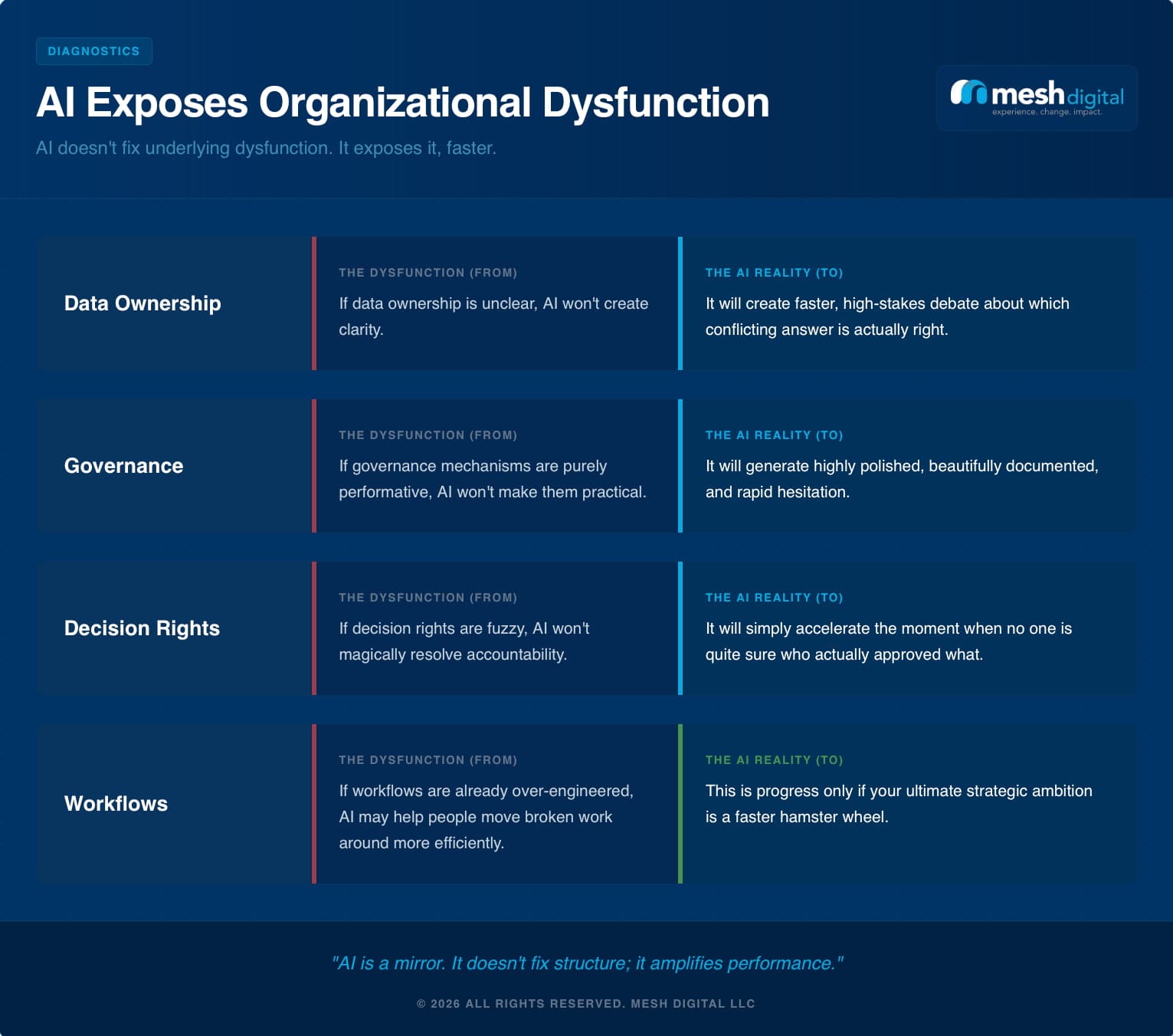
That's where many AI strategies quietly fail. They start with technology adoption rather than operating design. They inventory tools, rank use cases, define governance principles, and prioritize pilots. All of that can be useful. But if the underlying workflow, data, decision rights, accountability, and measurement model remain untouched, the strategy becomes a wrapper around inherited dysfunction.
The On The Cuff Tab
This is the operating model debt hiding underneath the AI conversation.
Operating model debt shows up when the business has accumulated too many disconnected processes, unclear ownership structures, brittle controls, redundant tools, weak data practices, and governance forums that review decisions rather than enable them. For years, that debt was tolerable because the business moved at human speed. AI changes the carrying cost (the Vig). It makes ambiguity more expensive.
The right starting point isn't, “Where can we deploy AI?” It's, “Where does the way we work need to change because AI is now available?”
That reframes matters. It moves the discussion from novelty to operating consequence. It forces the organization to distinguish between tasks that can be automated, decisions that can be augmented, judgments that must remain human-led, and workflows that should be rebuilt entirely. It also forces leadership to decide where authority sits when work is performed across employees, AI agents, applications, external partners, and data platforms.
The Operating Paradigm
This isn't a Chief Information Officer (CIO) problem. It's not a Chief Data & AI Officer problem. It's not a Chief Innovation Officer problem either. It's an enterprise operating model problem with technology implications.
- The CEO owns the ambition.
- The COO owns the operating rhythm.
- The CIO owns the enabling architecture.
- The CFO owns value discipline.
- The CISO and risk leaders own trust, control, and resilience.
- The CHRO owns workforce implications.
- Business leaders own adoption and outcomes. Data leaders own the trust layer that makes any of it usable.
Each function owns part of the answer. No function owns the whole.
That's precisely why a traditional AI strategy, standing alone, is too narrow. A serious AI agenda needs to become an operating model agenda. It should answer five executive questions:
- How does work need to flow differently?
- Which decisions should AI accelerate, recommend, escalate, or never touch?
- Which data domains are trustworthy enough to support scaled use?
- How will accountability work when humans and non-human employees participate in the same process?
- How will the enterprise measure value beyond activity, adoption, and demo enthusiasm?
These questions aren't academic. They determine whether AI becomes operating leverage or another layer of enterprise noise.
Stripping the Noise
For Boards and Executive Committees, the governance question should become more direct. Don't ask only whether management has an AI strategy.
That question changes the altitude of the conversation.
- A dozen pilots can survive unclear ownership. Scaled AI can't.
- A few productivity tools can coexist with inconsistent data. Enterprise decision support can't.
- An innovation sandbox can operate with lightweight governance. AI embedded into customer, employee, operational, financial, and regulated workflows can't.
Success is the Stress Test.
The companies that pull ahead won't be the ones with the longest AI roadmap or the most theatrical vision statement. They'll be the ones that convert AI from scattered experimentation into accountable operating capability. They will:
- Redesign workflows
- Clarify decision rights
- Establish data trust
- Modernize governance
- Protect human judgment where it matters, and
- Measure outcomes with enough discipline to know whether the work is creating value.
That's the real strategy.
So yes, write the AI strategy if the Board needs the artifact. There's nothing wrong with the document. The danger is confusing the document for the work.
The work is harder, more structural, and far more valuable.
Rethink the operating model. Then AI has somewhere useful to go.