The Programmable Physical Economy Is Becoming a Financial Services Market
Physical AI turns the programmable physical economy into a BFSI market. As assets become sensed, modeled, and verifiable, banks and insurers can underwrite using telemetry, price risk dynamically, finance intelligent infrastructure and secure non-human identities through stronger trust architecture.

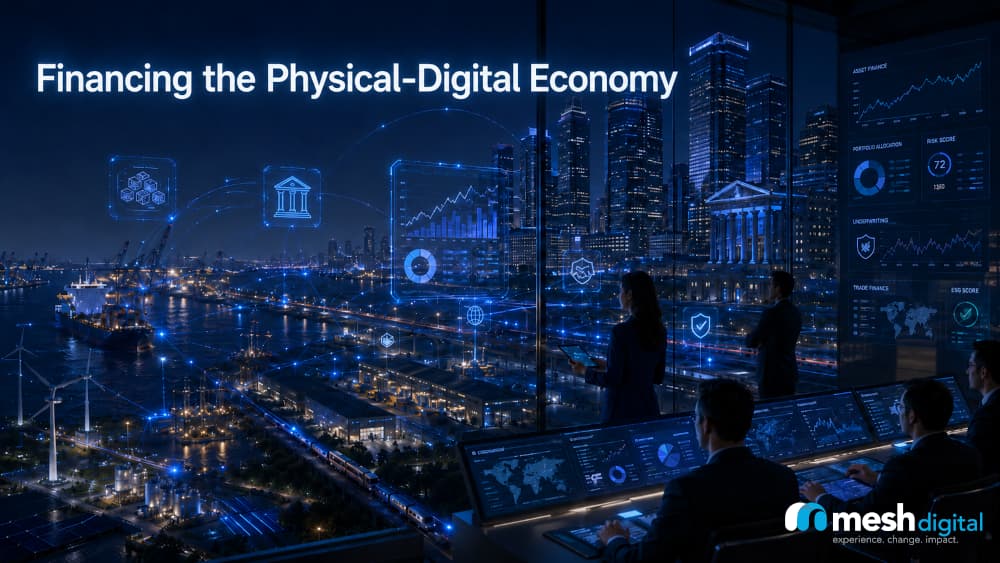
For Banking, Financial Services, and Insurance (BFSI) leaders, Physical AI is not simply an operating technology trend. It is an asset class, risk model, infrastructure financing opportunity, and trust architecture challenge arriving at the same time.
The programmable physical economy is the shift from physical assets that are merely financed, insured, and maintained to assets that are continuously sensed, modeled, authenticated, and orchestrated. Factories, logistics fleets, energy systems, robotics networks, healthcare assets, and urban infrastructure are becoming digitally addressable operating surfaces.
That matters because financial services has always been the industry that translates physical economic activity into capital flows, risk pools, liquidity, and trust. As the physical world becomes programmable, the financial architecture around it must become programmable too.
From Asset Ownership to Asset Intelligence
Traditional asset finance relies on periodic underwriting, static documentation, depreciation schedules, and borrower-reported performance. In a Physical AI environment, assets can produce real-time operational telemetry.
A robotic fleet, autonomous warehouse, smart grid node, or digitally twinned manufacturing line can reveal utilization, downtime, maintenance risk, performance quality, and operating context. That changes the underwriting model.
The opportunity is to move from “What is this asset worth?” to “What is this asset doing, how reliably is it performing, and how should capital price that performance?”
This creates room for dynamic asset-backed lending, usage-based insurance, real-time collateral monitoring, and new structures for tokenized real-world assets.
Insurance Moves From Claims to Prevention
For insurers, the most important shift is from reactive indemnification to proactive risk mitigation.
A programmable physical environment can detect anomalies before losses occur. A logistics insurer could price fleet risk based on real-time route conditions, autonomous system behavior, driver intervention patterns, and maintenance signals. A property insurer could use digital surface overlays and IoT telemetry to identify structural, environmental, or operational risks earlier.
This does not eliminate underwriting judgment. It upgrades it.
The winners will be carriers and brokers that turn telemetry into trusted risk intelligence without creating privacy, consent, or governance liabilities.
Identity Becomes the Control Fabric
Programmable physical systems introduce a major security question: who, or what, is authorized to act?
In this environment, identity is no longer limited to employees and customers. It must cover AI agents, robotic systems, APIs, devices, vendors, autonomous workflows, and digital twins. The risk is not only data loss. It is unauthorized physical action.
That is why IAM 3.0 becomes foundational. Mesh has written previously on the importance of cyber governance as a board-level control fabric, not simply a technology budget line (Mesh Digital, 2026). In a programmable physical economy, that point becomes sharper. The board must understand how identity, access, model governance, and operational resilience connect.
Strategic Questions for BFSI Leaders
Financial institutions should be asking:
- How will we underwrite intelligent physical assets?
- Can we price risk using live telemetry responsibly?
- What new lending, insurance, custody, or capital markets products emerge when physical assets become digitally verifiable?
- How do we govern non-human identities?
- Where do we need partner ecosystems to connect capital, technology, and execution?
Mesh Digital Perspective
For Banking, Financial Services, and Insurance firms, the programmable physical economy is not a distant robotics story. It is a near-term market structure story.
Capital will flow toward the organizations that can verify, finance, insure, and secure intelligent physical systems. The firms that treat this as a cross-functional strategy issue, not a niche innovation project, will be better positioned to capture the next wave of financial services growth.
Related Mesh Insights include “From Governance to Guardrails: The Board Must Shape Cyber, Not Just Fund Controls” and “Navigating the Digital Future: Key Challenges for U.S. Middle Market Banks.”