Physical AI and the New Operating Model for Healthcare
Physical AI shifts healthcare from digitized records to intelligent care operations. By sensing hospitals, clinics and home-care settings, leaders can improve flow, logistics, capacity and admin work while governing identity, consent, privacy, and safety automation augments staff, not replaces them.

Executive Summary
Healthcare leaders are under pressure from nearly every direction: workforce shortages, margin compression, administrative complexity, patient access challenges, cybersecurity risk, and rising expectations for digital convenience.
Physical AI will not solve all of this. But it may change the operating model.
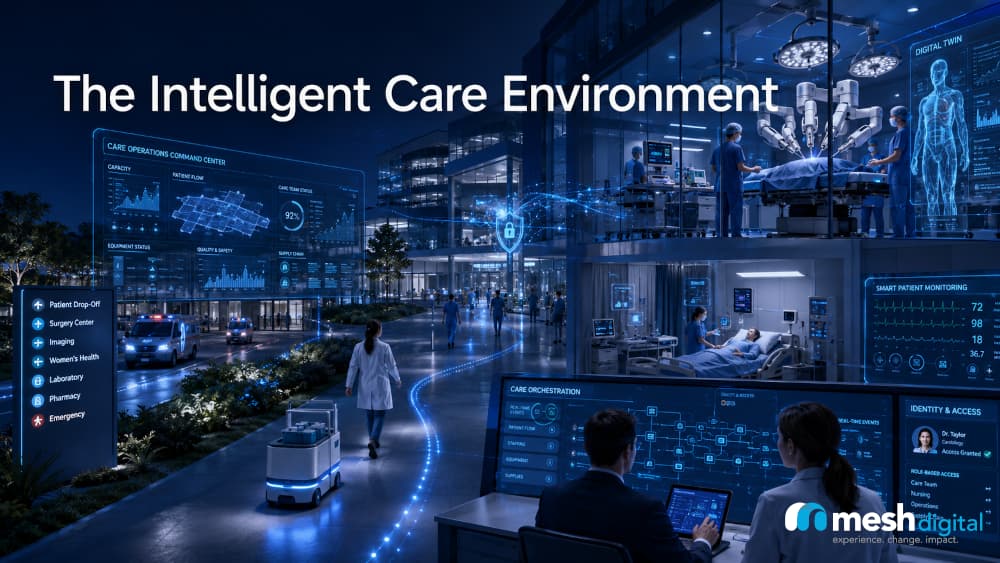
The programmable physical economy introduces a new idea for healthcare: care environments can become intelligent operating surfaces. Hospitals, clinics, surgical suites, supply rooms, labs, pharmacies, and home-care settings can be sensed, mapped, secured, and orchestrated in real time.
That is a major shift from digitizing records to digitizing care operations.
Beyond the EHR
For two decades, healthcare digital transformation has often centered on the electronic health record (EHR). That was necessary, but insufficient.
The next frontier is not simply documenting care better. It is helping care environments work better.
Physical AI can support clinical logistics, room turnover, patient flow, inventory movement, surgical planning, remote monitoring, rehabilitation, and administrative workflows. Digital surface overlays and digital twins can help leaders understand bottlenecks across the operating environment, not just inside the medical record.
This matters because healthcare’s core constraint is increasingly operational capacity.
Workforce Augmentation, Not Workforce Fantasy
Healthcare should be careful with sweeping claims about autonomy. Full replacement narratives are not credible in high-trust clinical environments.
The more practical opportunity is workforce augmentation.
AI agents can support documentation, triage routing, coding support, prior authorization workflows, inventory monitoring, and care coordination. Robotics and autonomous systems can support supply movement, pharmacy logistics, sanitation workflows, and controlled procedural assistance.
That can free clinicians and staff from work that is necessary but not always clinically differentiating.
In healthcare, the best automation strategy is not “remove the human.” It is “return the human to higher-value work.”
Identity and Consent Are Mission-Critical
The programmable care environment creates a sharper identity challenge.
Patients, clinicians, devices, AI agents, robots, third-party systems, and data-sharing networks all need trusted access. A compromised identity in healthcare is not just a cyber incident. It can delay care, expose protected health information, or disrupt physical operations.
That is why identity-first architecture, consent management, and non-human identity governance become essential.
Mesh has previously explored the need to cut through healthcare AI noise and focus on data barriers, outcomes, and operational value (Mesh Digital, 2025). That point carries directly into Physical AI. Poor data quality and weak governance won't just undermine analytics. They will undermine operational trust.
Strategic Questions for Healthcare Executives
Healthcare leaders should ask:
- Which operational bottlenecks are most ready for Physical AI augmentation
- Where can automation improve throughput without reducing trust?
- How will we govern AI agents and connected devices as non-human identities.
- Can digital twins help us model patient flow, staffing, and capacity before making capital investments?
- How do we protect privacy when care environments become continuously sensed?
Mesh Digital Perspective
Healthcare doesn't need more technology theater. It needs carefully governed, operationally grounded transformation.
Physical AI is powerful because it connects intelligence to the actual places where care is delivered. But the value will come from disciplined execution: clear use cases, safe workflow integration, measurable outcomes, and governance strong enough for clinical reality.
The future of healthcare AI will not be defined by the most impressive demo.
It'll be defined by safer care, better throughput, lower administrative drag, lower clinician churn, and more resilient operating models.
Related Mesh Insights include “AI in Healthcare: Cutting Through the Noise & Overcoming Data Barriers for Success” and “Strategies for Improving U.S. Healthcare Outcomes and Managing Costs Through Digital Innovation.”