Patient Access: Who Owns the Referral After the First Call?
Automating intake and scheduling doesn't guarantee patients receive care. Health systems must assign clear referral ownership, manage exceptions, and track actual visit completion alongside front-end efficiency so AI-driven capacity gains translate into real patient access and financial value.

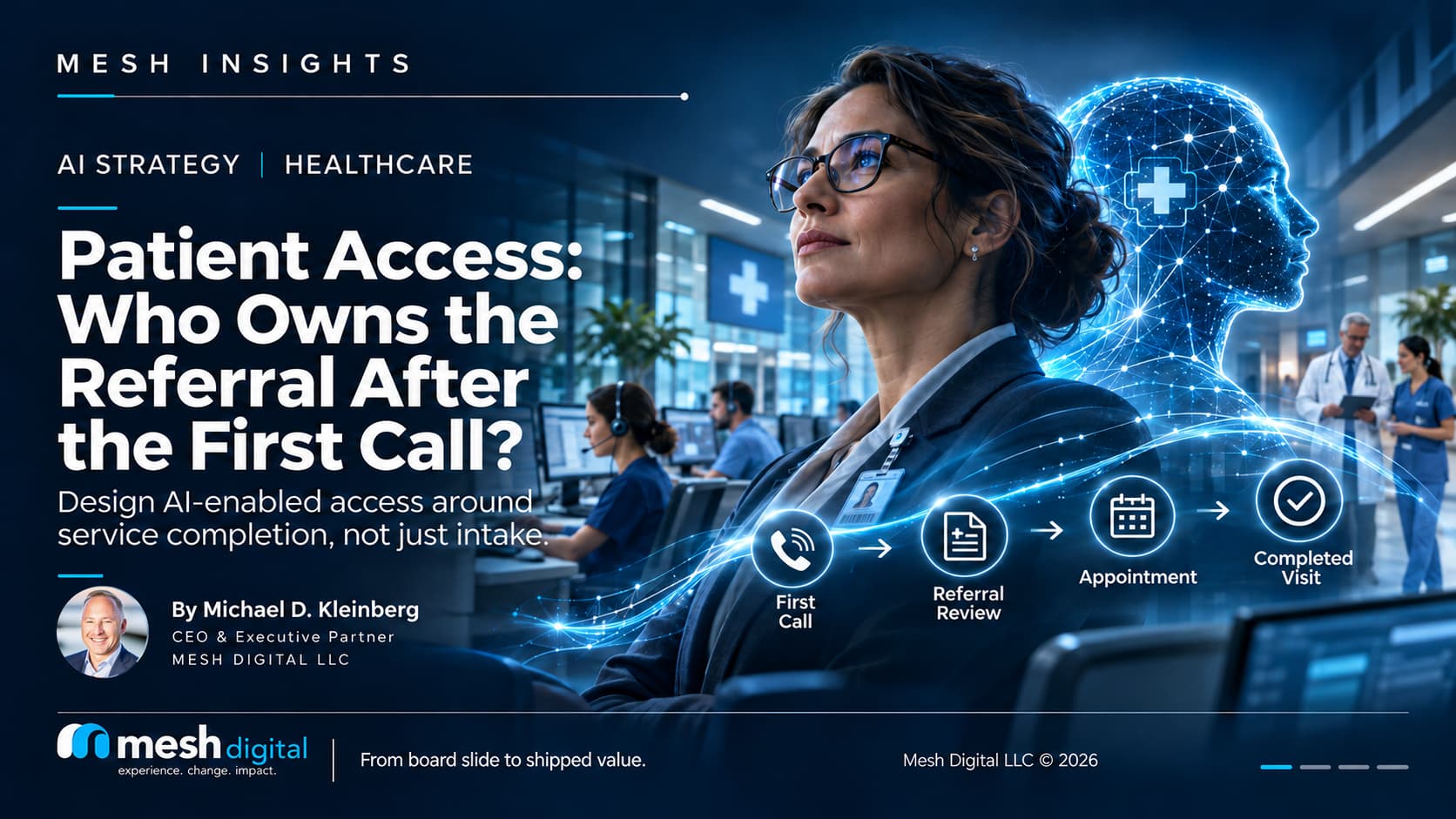
The healthcare AI conversation is increasingly moving beyond answering questions and into the work of getting patients to the right place. That’s a welcome development. But when a health system invests in a new access capability, I would want to know whether we have made it easier to reach the organization, easier to make an appointment, or easier to actually receive the service. Those are three different operating outcomes.
At HLTH, the discussion around consumer and patient-facing AI brought this distinction into sharper focus. Outside the conference, Cleveland Clinic announced a partnership with Luminai on September 9, 2026 to automate health system operations, including the movement of faxed referral information into its records. It's an example of an organization addressing administrative work at the front of a workflow. The announcement doesn't establish that more patients completed visits.
There’s a useful lesson from an earlier, non-AI intervention. An observational study of eConsult implementation at NYC Health + Hospitals, published in JAMA Health Forum in 2021, reported improved scheduling among referrals requiring a follow-up visit, but no statistically significant change in specialist visit completion within 90 days (38.4% before versus 37.9% after; P = 0.07). A concurrent electronic health record transition complicates interpretation. The result shouldn't be generalized to every referral program, and the study didn't evaluate AI. What it does offer is a reason to be disciplined about the distinction between getting someone onto a schedule and getting them served.
The work begins before the appointment
Imagine a patient who contacts a specialty practice after hours. An automated service receives the request and collects the necessary administrative details. The next morning, the referral reaches a scheduling team, but a required document is missing. The team has to contact another office. Meanwhile, the patient has received an acknowledgement and reasonably expects that somebody is taking care of the request.
Who is accountable at that point?
If the referral remains in a queue with an unclear next owner, the introduction of AI may have improved one activity while leaving the fundamental operating problem intact. In another scenario, the process could assign the exception immediately, establish a time for resolution and communicate a meaningful update to the patient. The same technology can produce a very different service experience depending on how the work is designed.
This is where I'd start when considering Intelligent CapacityTM. We have an opportunity to rethink the workflow around the combined capacity of people and AI. Some administrative steps may be eliminated, others simplified, and some handoffs redesigned altogether. Clinical questions, urgent escalation and decisions about appropriate care still require the relevant clinical authority and procedures. The objective is to give staff the context and capacity to handle the work that needs their judgment.
Design around completion
For a defined service line, I'd ask the access leader and the clinical or operational owner to agree on a small set of measures before changing the process.
Start with the date of first contact and the date the referral is received. Measure the wait for a complete referral, scheduling activity, appointments booked and visits completed. Record alternative documented resolutions, such as a patient choosing another route, separately from completed visits. Maintain visibility of open cases within a consistent cohort and time window.
Where relevant, measure whether the referring clinician receives the specialist's report. CMS's 2026 Closing the Referral Loop measure, CMS50v14, specifically addresses receipt of the specialist report by the referring clinician. It's a separate measure from booking or completing an appointment, and its published specifications govern its use.
Together, those distinctions help an executive see where work is progressing and where it remains stuck. They also protect against an attractive dashboard that excludes referrals still waiting for resolution.
There’s an economic dimension. If intake requires fewer manual touches, that can release staff capacity. Whether that capacity translates into better access, fewer overtime hours, greater throughput or another measurable benefit depends on what the organization does with it. A CFO and an access leader should agree on that intended benefit, its baseline and the costs of achieving it before projecting a return. A time-saving alone doesn't establish captured financial value.
A practical place to begin
Take one ordinary referral and one exception. Use fictional examples or appropriately de-identified information in a short working session. Follow each through first contact, referral receipt, scheduling, service completion or a documented alternative disposition. For the exception, identify the next owner, the deadline, the escalation route and how the patient receives an update. Ask what happens when that owner is unavailable.
That exercise can reveal whether the next investment should go into intake automation, a redesigned handoff, additional capacity at a downstream constraint, or a different approach entirely. Protect language access, accessibility, patient choice and appropriate clinical escalation while testing any proposed change.
From my experience working with clients, the bias should be to have an operating team bring one well-understood referral path to an investment discussion than a broad inventory of promising AI capabilities. It gives leadership something concrete to improve, measure and govern. And it gives the patient a better defined path through the organization.