Who Owns the Decision When Everyone Supports AI?
AI support delivers value when leaders assign decision rights. Business owners need authority to redesign workflows, align incentives, settle disputes, and act on trusted intelligence. CEOs set the boundaries, escalation paths, and accountability to turn Intelligent Capacity into measurable results.

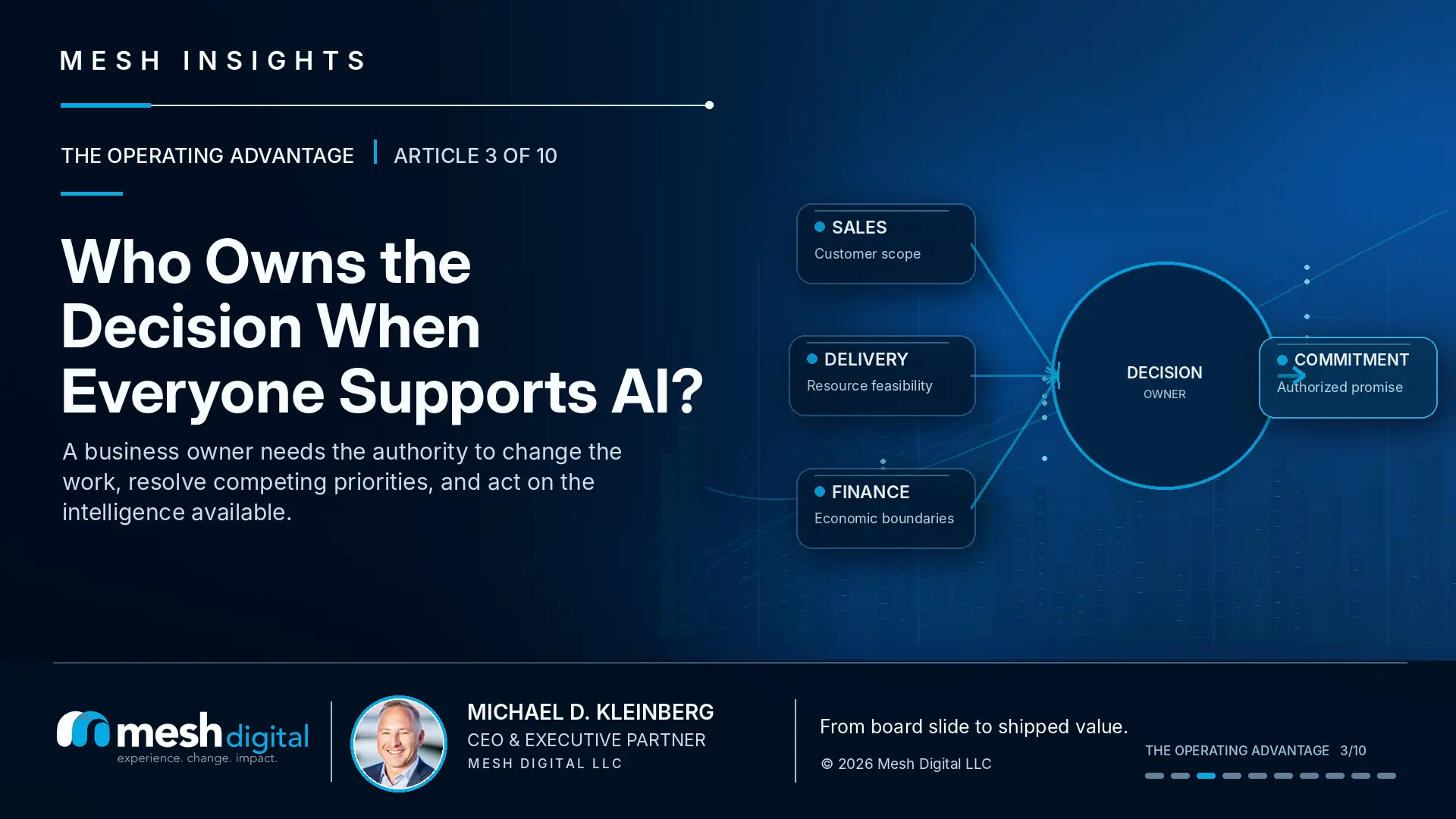
A business owner needs the authority to change the work, resolve competing priorities, and act on the intelligence available.
The first serious test of an operating redesign comes when someone has to give something up. An approval moves. A departmental target changes. A manager can no longer require every decision to pass through the same familiar checkpoint.
Until that moment, support can be remarkably easy to secure. The leadership team agrees that customers should receive answers sooner, experienced employees should spend less time coordinating work, and Intelligent Capacity™ should improve how the enterprise performs. The difficulty begins when those ambitions require a specific redistribution of authority.
In the earlier articles in this series, we examined how human and nonhuman capacity can change the economics of work and where to look for the value streams worth redesigning. The next step is to give someone a workable mandate. An executive responsible for an outcome needs enough authority to change the conditions that determine it.
Put authority behind the customer promise
Consider a hypothetical services business preparing a proposal. Sales develops the scope, delivery estimates the resources, and finance reviews the economics. Each group can change an assumption on which the others depend. The proposal circulates until everyone is comfortable, while the customer waits.
Intelligent Capacity™ could help the team evaluate feasible combinations of scope, timing, and price together. The analysis might reveal several acceptable options before a commitment is made. But the redesign still depends on a management decision: who may choose an option and commit the business?
I would define that authority around the actual commitment. A designated owner could approve a proposal when the evidence demonstrates that it meets agreed delivery and commercial conditions. Delivery would own the validity of its capacity information. Finance would establish the economic boundaries. Material departures would require a decision from someone authorized to accept the consequences.
This gives the owner a decision they can make. It also gives the other functions a clear way to protect the obligations for which they remain responsible. The process can move without requiring a fresh negotiation over ownership each time.
The same principle applies to the redesign itself. The mandate should state which handoffs the owner may remove, which responsibilities may be reassigned, and which changes require a broader executive decision. Otherwise, an owner can be accountable for performance while remaining dependent on permissions they cannot obtain.
Align the incentives with the mandate
Authority can be clear on paper and ineffective in practice when performance measures pull leaders in different directions.
In our example, sales might be rewarded for bookings, delivery for utilization, and finance for margin. A proposal that improves one measure can make another harder to achieve. Those tensions deserve explicit management choices. They cannot be resolved by asking an intelligent system to produce a more persuasive recommendation.
The CEO should establish the governing outcome and the trade-offs the organization is prepared to make. For this business, that might be a feasible customer commitment with acceptable contribution and delivery quality. Functional measures should support that result. An executive who improves a local target by repeatedly delaying the customer decision should expect the broader consequence to be examined.
This is also where a flatter organization needs more than a revised reporting chart. If every disagreement still rises to the CEO, the enterprise has concentrated its decision queue at the top. Delegation needs to move specific choices closer to the people with the context and competence to make them.
The management layer that remains then has a different job: resolving material trade-offs, developing judgment, and improving the conditions under which teams can act.
Make disagreement useful
A sound mandate preserves challenge. Delivery must be able to question an unsupported resource assumption. Finance must be able to identify terms outside the agreed economics. The value stream owner needs a route to resolve those concerns before a customer promise is made.
The escalation should carry the disputed assumption, the available options, the consequences of waiting, and a named decision owner. It should also explain what happens while the decision is pending. The team may continue preparing alternatives while withholding the commitment. An absent response cannot quietly become permission.
Human and nonhuman workers can help assemble that evidence and carry out an authorized decision. The authority comes from the mandate established by management. A system's ability to generate an answer does not establish permission to act on it.
Delegation should also be adjustable. Repeated exceptions may show that the boundaries are poorly designed, that information is unreliable, or that an approval could move closer to the work. The executive review should examine those patterns and revise the mandate where the evidence supports it.
Test the decision before expanding the work
At the next operating review, I would take one customer commitment that repeatedly stalls and ask the responsible leaders to work through an ordinary case and a difficult exception. Who decides? What evidence must be present? Who can challenge the decision? Where does an unresolved disagreement go?
Then examine the elapsed time and rework around that decision. A clearer mandate should make the operating result observable: fewer avoidable escalations, more dependable commitments, or less time waiting for authorization. Where those improvements fail to appear, investigate the design rather than assuming people simply need to collaborate harder.
Intelligent Capacity™ can bring more analysis to a decision and more execution capacity behind it. The CEO must establish who is empowered to use that capacity and answer for the consequence. That is how executive support becomes an operating mandate.
Michael D. Kleinberg
CEO & Executive Partner | Mesh Digital LLC | © 2026 All Rights Reserved