Intelligent Capacity™ Is Changing the Economics of the Enterprise
Enterprises were built around scarce human intelligence. Intelligent Capacity changes that equation. By combining human and nonhuman workers, CEOs can eliminate complexity, redesign operations and management, and convert expanded capacity into measurable business value with clear accountability.

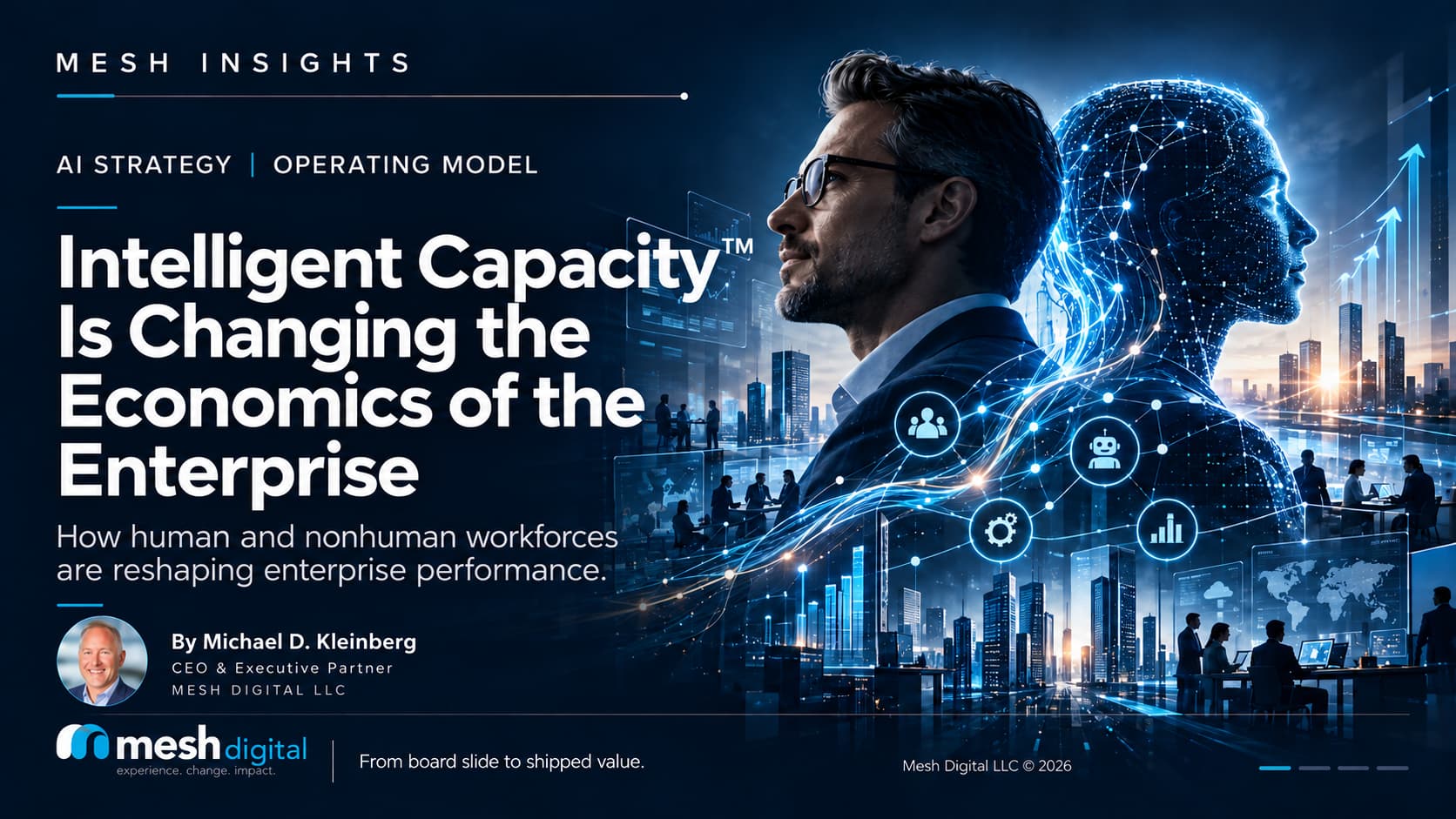
The modern enterprise was built around the scarcity of human intelligence. That constraint is changing, and so are the assumptions underlying how we organize, manage, and operate businesses.
For generations since the industrial revolution, CEOs competed by deploying capital, labor, time, and assets effectively. We built functional departments, management hierarchies, specialized roles, and approval processes to coordinate work and maintain control as complexity grew. These structures reflected the capabilities and limitations of the human workforce.
Now intelligence is becoming a scalable operating resource, augmenting people and increasingly executing work independently.
At Mesh, we define Intelligent Capacity™ as the combined productive capacity of human and nonhuman workers (AI / SI Agents) to achieve business outcomes at an acceptable cost, quality, speed, and level of risk.
For CEOs, this fundamentally changes the economics of work, creating a rare opportunity to rethink organizational design, management, and enterprise performance without the organizational debt baggage.
Rethinking the Capacity Constraint
In my earlier article, The CEO's Guide to AI-Native Transformation, I argued that becoming AI-native requires rethinking the enterprise operating model.
Intelligent Capacity™ takes that argument further.
Historically, expanding an organization's ability to perform complex work generally required more people, greater specialization, or significant investment in productivity improvements.
A growing business needed additional analysts, coordinators, managers, and specialists. Scaling operations frequently meant scaling the organization supporting them.
Intelligent Capacity™changes that relationship.
Organizations can increasingly draw upon nonhuman capabilities to perform analysis, coordinate activities, reconcile information, monitor operations, and execute defined responsibilities. These capabilities can work alongside employees, extending the amount and complexity of work an organization can undertake.
Consider the implications for a highly experienced professional.
Whether that individual is an underwriter, consultant, physician, or operations executive, their greatest contribution often comes from applying judgment, solving difficult problems, managing relationships, and making consequential decisions.
Yet much of their working capacity is consumed by preparing information, coordinating activities, and navigating administrative processes.
Intelligent Capacity™ creates an opportunity to redirect that scarce human attention toward higher-value responsibilities while assigning appropriate work to nonhuman resources. As that capacity becomes available, the limitations imposed by traditional resource models begin to change.
The more consequential opportunity emerges when we reconsider how the entire operation should function.
When the Work Changes, the Organization Must Follow
Consider customer onboarding. Sales originates the relationship, legal reviews contracts, operations validates information, finance establishes records, and delivery activates the service. Each function has its own oversight and performance measures. As volumes grow, organizations add people and management layers to coordinate increasingly complex handoffs.
Intelligent Capacity™ changes that equation. Information is continuously reconciled, validations automated, and exceptions routed with supporting evidence. Human specialists focus on judgment and accountability while the business handles greater volume with less administrative effort.
But why preserve handoffs, functional activities, and management layers that no longer contribute to the customer outcome? Imagine one accountable owner, shared information, delegated decisions, and human and nonhuman workers operating toward the same outcome.
This fundamentally changes operating economics, organizational structure, and leadership expectations.
The greatest opportunity from Intelligent Capacity™ may come from eliminating organizational complexity, rather than simply accelerating existing work.
The Changing Role of Management
Management hierarchies evolved around how many people, activities, and decisions a leader could effectively coordinate, supervise, and escalate.
Intelligent Capacity™ expands that span of control. Leaders can direct employees, specialists, automated processes, and nonhuman workers, shifting their focus toward allocating capacity, managing exceptions, improving performance, and delivering outcomes. This creates opportunities for fewer management layers and greater accountability.
But managing AI agents introduces new responsibilities: clear mandates, defined authority, performance expectations, and oversight. Their work must be observable, consequential decisions explainable, and actions governed by appropriate controls.
At Mesh, we've adopted a straightforward principle:
Increase autonomous execution, not autonomous authority.
Routine work should progress within established boundaries. Intelligent systems can monitor and validate one another, escalating exceptions when appropriate. Consequential decisions remain subject to accountable human authority.
The organizational implications will vary by business. Some functions may become considerably leaner. Others may require additional specialized oversight or different skills. Certainly, different thinking around how to solve for their capacity needs.
The common requirement is to redesign management around the work, the decisions, and the outcomes the enterprise needs to deliver.
Converting Intelligent Capacity™ Into Enterprise Value
Reducing administrative work releases capacity. Enterprise value depends on what leadership does with it: increase throughput without proportional hiring, improve customer service, redirect experienced talent toward revenue, or reduce operating costs. Each carries different financial and organizational implications.
Intelligent Capacity™ belongs on the CEO, COO, CHRO, and CFO agenda. Workforce planning must account for human and nonhuman resources together, while operating economics reflect the full cost of outcomes, including oversight, exceptions, and rework. Finance must distinguish potential productivity from benefits actually realized.
Traditional workforce metrics remain relevant, but throughput, cost per outcome, cycle time, quality, customer impact, and the deployment of scarce human expertise provide a more complete picture.
The economic advantage comes from converting released capacity into measurable enterprise performance. That's a management responsibility.
The CEO's Next Operating Decision
CEOs should examine where expensive human attention, organizational boundaries, and operational inefficiencies constrain performance, and where Intelligent Capacity™ could fundamentally change the economics.
Then empower an accountable executive to redesign the work.
Assess current costs, constraints, decision rights, and delays. Eliminate unnecessary complexity, rethink responsibilities, and deploy Intelligent Capacity™ where it creates measurable value.
Demonstrate improved outcomes, acceptable economics, and effective controls before scaling. This requires challenging established assumptions about organizational design, workforce planning, and management while concentrating human talent where it matters most.
The next era of enterprise performance will be shaped by how intelligently we organize capacity itself.
If you were designing your enterprise today, with Intelligent Capacity™ from the outset, would you build the organization you currently lead?
Michael D. Kleinberg
CEO & Executive Partner | Mesh Digital LLC
Next in The Operating Advantage series: Identifying the value streams where Intelligent Capacity can deliver measurable business and economic returns.
Mesh Digital LLC © 2026