Insurance In Motion: Turning Fragmented Modernization Into Segment-Specific Performance
Insurance In Motion argues carriers must stop isolated modernization and connect underwriting, claims, distribution, data, AI, risk, and resilience into one accountable operating motion that improves decisions, trust, growth, and combined ratio impact.

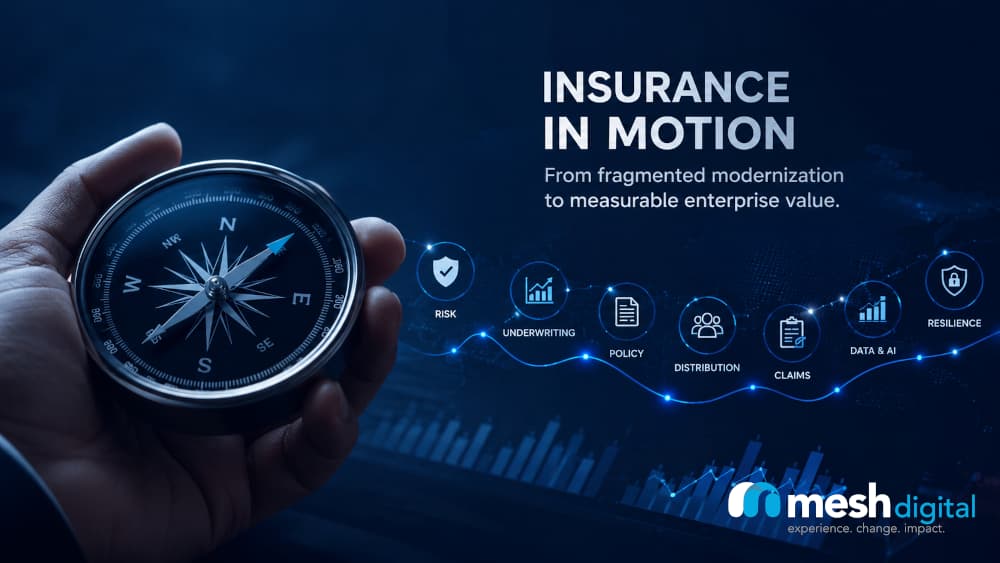
Insurance carriers do not need more isolated modernization. They need modernization that moves the business.
That distinction matters in 2026 because the U.S. insurance market is not moving as one market. Property and casualty (P&C) carriers are entering a more cautious period after several years of hard-market pricing. Commercial property is stabilizing and, in some lower-risk segments, softening. Commercial auto and casualty remain under pressure from repair inflation, litigation trends, and social inflation. Life and annuity carriers are benefiting from stronger investment yields, long-duration asset strategies, and continued deal activity. Health plans and employee benefits leaders are facing a very different reality, with employers bracing for another sharp increase in medical cost trend, driven by utilization, provider pricing, specialty drugs, and GLP-1 demand.
Cyber, meanwhile, has moved from specialty adjacency to board-level risk infrastructure. Large commercial buyers are also re-evaluating insurance programs as risk becomes more complex, interconnected, and expensive to manage.
So no, there's no single “insurance industry” condition. There are multiple insurance markets moving at different speeds, under different margin pressures, with different modernization mandates.
That's exactly why isolated transformation is no longer enough.
Stabilization is not the same as simplicity
The shift from hard-market conditions toward cautious stabilization may sound like relief. It's not a return to easy operating conditions.
For many P&C carriers, premium growth is moderating while claims severity, catastrophe exposure, litigation trends, and expense pressure remain active constraints. A combined ratio drifting closer to breakeven changes the operating conversation. When margins tighten, execution quality matters more, not less.
For commercial property, softening rates in better-performing risk segments may reduce some pressure on buyers, but it also raises the bar for carrier discipline. Growth for growth’s sake becomes dangerous when pricing power fades.
For commercial auto and casualty, the story is different. Repair costs, parts availability, medical inflation, nuclear verdicts, and litigation financing continue to pressure loss costs. These lines need sharper risk selection, faster claims intelligence, better litigation management, and stronger portfolio monitoring.
For life and annuity carriers, profitability and revenue momentum may be stronger, but the operating agenda is still complex. Distribution, policyholder experience, capital efficiency, M&A integration, legacy platform constraints, and data modernization remain critical.
For health and benefits leaders, affordability is the strategic fault line. Employers are absorbing steep healthcare cost increases while asking whether their benefits strategy is sustainable. That creates pressure on plan design, navigation, pharmacy economics, care management, and member experience.
Different markets. Different economics. Same underlying problem.
Fragmentation is now an economic issue
Insurance modernization has often been organized by functional domain.
Underwriting gets a workbench. Claims gets a platform. Distribution gets a portal. Data teams build infrastructure. Cyber teams strengthen controls. Customer experience teams redesign journeys. Each investment may improve a piece of the operating model.
But insurance value is not created in pieces. It's created through the connected system of selecting, pricing, servicing, and protecting risk.
Fragmentation shows up when underwriting lacks timely claims intelligence. It shows up when actuarial, claims, product, and finance teams debate different versions of loss experience. It shows up when brokers face slow appetite confirmation, duplicative submission requirements, or inconsistent service. It shows up when claims data becomes a historical record instead of a live signal for pricing, product design, and portfolio action.
It also shows up when AI pilots can't scale because the workflow, data, governance, and adoption models were never designed as one system.
The cost is material. Fragmentation slows decisions, weakens risk selection, increases expense, creates claims leakage, damages broker relationships, and makes executive control harder.
The scoreboard changes by segment, but accountability doesn't
For P&C Carriers
The scoreboard often centers on loss ratio, expense ratio, claims leakage, rate adequacy, catastrophe exposure, litigation severity, and combined ratio performance.
For Commercial Auto & Casualty
The emphasis shifts toward severity management, reserving discipline, claims triage, legal expense, risk selection, and portfolio monitoring.
For Life & Annuity Providers
The scoreboard includes capital efficiency, distribution productivity, persistency, policyholder experience, operational cost, regulatory confidence, and integration performance.
For Health Plans & Benefits Leaders
The scoreboard is affordability, medical cost trend, member experience, care navigation, pharmacy management, administrative efficiency, and employer value.
For Cyber Insurers
The scoreboard is underwriting precision, accumulation risk, threat intelligence, loss prevention, claims response, and the ability to price an adversarial risk that keeps changing.
Different scoreboards. Same leadership mandate: connect modernization to measurable business outcomes.
AI must improve decisions, not decorate workflows
AI will be central to the next era of insurance performance. It can support underwriting, claims triage, fraud detection, servicing, document analysis, risk monitoring, portfolio insight, and operational efficiency.
But AI will not fix a fragmented carrier. It may simply help fragmentation move faster.
If data definitions are inconsistent, AI inherits the inconsistency. If workflows are poorly designed, AI accelerates poor workflow. If decision rights are unclear, AI creates governance friction. If frontline users do not trust the outputs, adoption stalls. If compliance and risk teams are brought in late, the pilot gets trapped between ambition and control.
Better underwriting decisions. Better claims decisions. Better pricing decisions. Better service decisions. Better portfolio decisions. Better executive decisions.
That requires more than models. It requires a decision architecture: trusted data, clear governance, embedded workflows, explainable outputs, adoption discipline, and performance feedback loops.
The carriers that win with AI won't be the ones with the most pilots. They'll be the ones that connect AI to the operating mechanics of insurance value.
Claims is the trust moment and the intelligence engine
Claims is where the insurance promise is proven or lost. That truth applies differently by segment, but it applies everywhere.
In P&C, claims execution shapes loss costs, leakage, litigation outcomes, customer trust, and reserving confidence. In commercial auto and casualty, claims severity and legal strategy can determine whether underwriting profit survives. In health, claims and care navigation influence affordability, member experience, and employer confidence. In cyber, the claims response is often inseparable from the product itself.
Better triage can reduce leakage. Stronger documentation can improve coverage handling and litigation posture. Faster resolution can improve satisfaction. Better vendor orchestration can reduce severity. Cleaner claims intelligence can improve underwriting, pricing, product design, and risk appetite.
Claims data shouldn't sit downstream as evidence of what already happened. It should move upstream as intelligence for what the carrier should do next.
Distribution friction is a growth tax
Distribution is not just a channel. It is a performance system. Broker, agent, advisor, employer, and partner experience directly affect submission quality, conversion, retention, persistency, and profitable growth. Slow responses, unclear appetite, manual intake, duplicative data entry, weak transparency, and inconsistent service all impose a tax on growth.
Carriers often respond by improving the digital front end. That helps, but only if the operating model behind it improves as well.
A better broker portal doesn't solve slow underwriting decisions. A cleaner enrollment experience doesn't solve unaffordable benefit design. A new advisor tool doesn't fix poor service integration. A workflow application doesn't solve unclear ownership.
The goal isn't simply to look easier to do business with. The goal is to become easier to do business with, while protecting discipline.
Risk can't be priced well from fragmented data
Insurance runs on risk information, yet many carriers still struggle with disconnected data environments, inconsistent definitions, manual reconciliation, and limited cross-functional visibility.
This is more than a data management issue. It's a risk pricing and enterprise control issue.
If underwriting, actuarial, claims, product, finance, and distribution don't operate from aligned signals, the enterprise loses speed and confidence. Decisions take longer. Portfolio drift becomes harder to see. Loss trends are detected too late. AI becomes harder to trust. Executives manage through lagging indicators when they need earlier signals.
Can we price risk with more confidence? Can we see emerging loss trends earlier? Can we identify claims severity sooner? Can we reduce underwriting drag? Can we improve submission quality? Can we monitor portfolio drift? Can we support AI safely? Can we give leadership a cleaner view of enterprise performance?
If not, the data program may be technically impressive and commercially underpowered.
Resilience is part of the product
For insurers, cyber and operational resilience are no longer just internal control topics. They are part of the market promise.
A carrier that can't protect data, sustain operations, recover from disruption, or preserve trust during a crisis weakens the very proposition it sells. This becomes even more important as carriers depend on cloud platforms, data providers, AI systems, brokers, service vendors, healthcare networks, pharmacy ecosystems, and digital distribution partners.
Resilience must be designed into the operating model. Identity, access, data protection, vendor risk, incident response, recovery planning, executive decision rights, and customer communications have to work together.
Resilience can't live in a binder, a board appendix, or an annual exercise that politely checks the box. It has to be provable.
From modernization lanes to accountable motion
The leadership mandate is clear: stop modernizing in silos.
Insurance leaders need to connect strategy, workflow, data, AI, resilience, distribution, and execution into one enterprise motion. That requires a different model than the traditional advisory-to-implementation handoff, where intent gets translated through too many teams, tools, vendors, and governance forums before it reaches measurable outcomes.
This is exactly where Mesh Digital’s role as an Ecosystem Orchestrator™ is intentionally different.
Mesh helps insurance leaders move from board intent to operating impact through Strategy-in-Motion PODs™: focused, cross-functional execution teams designed to connect strategy, workflow redesign, digital engineering, data enablement, AI readiness, and performance management around the outcomes that matter.
For P&C Leaders
That may mean connecting underwriting, claims, data, and portfolio management to protect margin as rates stabilize.
For Commercial Auto & Casualty Leaders
It may mean improving claims intelligence, litigation visibility, risk selection, and severity management.
For Life & Annuity Leaders
It may mean modernizing distribution, operating efficiency, customer experience, and integration execution.
For Health & Benefits Leaders
It may mean improving affordability, member navigation, pharmacy insight, and administrative performance.
For Cyber Leaders
It may mean strengthening underwriting precision, control signals, incident response, and accumulation risk management.
The carriers that compound will separate from the carriers that pilot
The next wave of insurance transformation won't be won by the carriers with the most pilots, the largest technology budgets, or the longest roadmap. It'll be won by the carriers that can orchestrate the business as a connected system.
Underwriting connected to claims. Claims connected to data. Data connected to risk. Risk connected to distribution. Distribution connected to experience. Experience connected to resilience. Resilience connected to trust. Trust connected to growth. Growth connected to enterprise value.
Not digital modernization for its own sake. Modernization that compounds. Insurance accountable motion from strategy to segment-specific performance.