The Programmable Reality: Architecting the Digital Surface Across the $50 Trillion Physical Economy
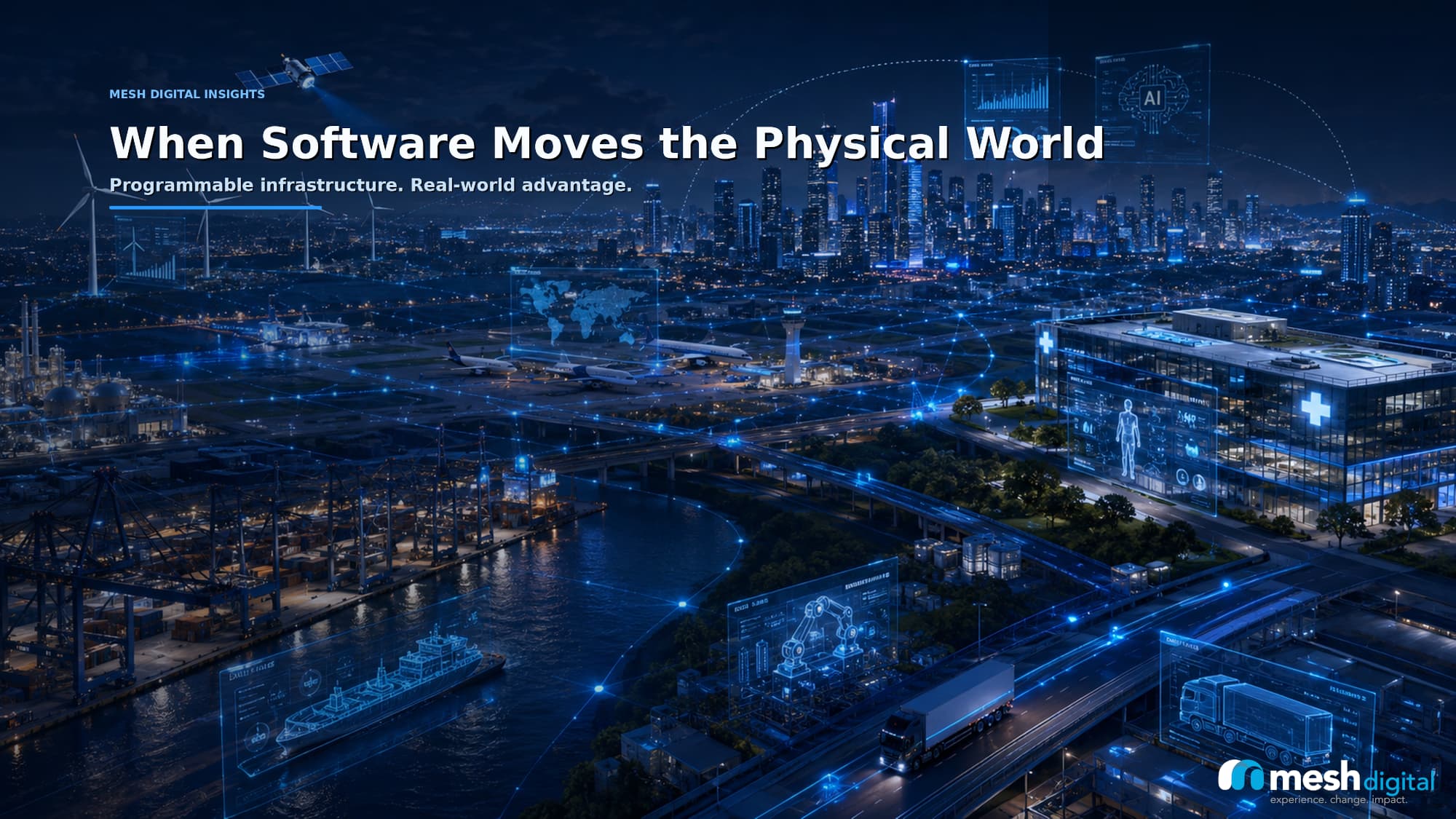
Physical AI is turning the $50T physical economy into a programmable surface, where digital overlays, edge compute, robotics, and identity-first security orchestrate factories, logistics, healthcare, cities, and startups into safer, smarter, software-defined operations at global scale today.

Executive Summary: The "So What?"
The physical world, a $50 trillion operational expanse, is finally becoming programmable. Through Physical AI and the Digital Surface Overlay (DSO), software is no longer confined to digital screens; it actively orchestrates physical atoms. For enterprise leaders, this signifies the end of isolated, rigid automation and the dawn of continuous, software-defined physical operations. Organizations that master this physical-digital convergence will fundamentally redefine their unit economics, while those relying on legacy cyber-physical systems will face rapid obsolescence. To secure this new frontier, organizations must completely rethink their security architecture, treating identity as the ultimate and only viable perimeter.
The Convergence of Bits and Atoms
For over four decades, the software revolution has operated within a strictly digital paradigm. Software transformed the transmission of information, the allocation of capital, and the distribution of media, yet the material world—comprising factories, logistics networks, healthcare facilities, and urban infrastructure remained largely insulated from direct programmatic control. Historically, the physical environment defied frictionless software manipulation due to the unstructured nature of reality. The sheer complexity of atomic interactions, chaotic physics, and real-world unpredictability meant that industrial operations required rigid, single-purpose machinery.
This limitation is dissolving. The emergence of Physical AI, artificial intelligence embedded within robotic systems and autonomous agents capable of perceiving, reasoning, and acting within the real world marks a definitive architectural shift. By synthesizing embodied robotics, high-density edge computing, and persistent spatial mapping, Physical AI provides the technological foundation to cast a seamless Digital Surface Overlay (DSO) across the material economy.
The Digital Surface Overlay functions as a persistent, spatially-aware computational layer superimposed directly onto physical infrastructure. It translates the physical world into a continuously updated digital state, allowing organizations to query, index, and orchestrate physical assets with the velocity and precision of a cloud-native database. As advanced machine intelligence bridges the digital and physical domains, industrial operators gain the capability to unlock productivity across a $50 trillion Total Addressable Market (TAM) that encapsulates the foundational pillars of the global physical economy.
Sizing the $50 Trillion Operational Canvas
The magnitude of the Physical AI opportunity requires a recalibration of how technology markets are measured. While the digital information technology sector operates within a trillion-dollar paradigm, the integration of autonomous systems into physical value chains exposes a vastly larger economic canvas. The global physical economy encompassing everything that moves, manufactures, or sustains life represents a $50 trillion operational expanse historically bottlenecked by human labor constraints and mechanical inefficiencies.
The acceleration toward a programmable physical economy is driven by acute macroeconomic and demographic imperatives. Global supply chains face structural vulnerabilities, compounded by rising operational costs and escalating product variability. Most critically, persistent labor shortages threaten to cap industrial output. Projections indicate 2.1 million unfulfilled manufacturing positions by the end of the decade, driven by an aging workforce and shifting skill availability.
Physical AI systems provide a robust solution to these bottlenecks. Traditional industrial automation delivered substantial value in highly controlled, static environments but failed in dynamic settings requiring adaptability. In contrast, embodied AI systems learn and execute tasks autonomously, transforming capital expenditure on hardware into variable labor equivalents. This dynamic reshapes unit economics, substituting human physiological limitations with continuous, scalable machine execution.
Analyst models project the foundational Physical AI market to scale from approximately $1.50 billion in 2026 to $15.24 billion by 2032, reflecting a Compound Annual Growth Rate (CAGR) of 47.2%. Alternative models, incorporating the broader integration of AI compute, sensing hardware, and autonomous systems, forecast market expansion to $960.38 billion by 2033, growing at a 36.1% CAGR. The highest-bound estimates project the total ecosystem value at $2.4 trillion by 2032, recognizing the vast secondary markets created by the Digital Surface Overlay. Furthermore, longitudinal forecasts indicate that cumulative transport spending alone will reach $50 trillion by 2050 as mobility networks modernize and cities grow.
| Economic Sector | Transformation Vector | Projected Market Impact | Core Operational Advantages |
| Manufacturing | Autonomous factories, humanoid deployment, predictive digital twins | $15.24B foundational hardware/software market by 2032 | Elimination of changeover latency, continuous 24/7 production scaling, precision assembly |
| Logistics & Warehousing | Autonomous Mobile Robots (AMRs), swarm orchestration, real-time spatial navigation | Driving efficiency in global transport spending ($2.4T annual by 2050) | High operational velocity, mitigation of workforce attrition, error reduction |
| Urban Infrastructure | Smart City Overlays, subsurface utility mapping, decentralized traffic management | Utility power spending scaling from $631B to $1.1T annually by 2050 | Optimized grid resilience, reduction in municipal maintenance expenditures, contextual data mapping |
| Healthcare & Surgical | Haptic-guided surgical tools, autonomous patient care, dexterous manipulation | Integration into multi-trillion dollar global healthcare sector | Enhanced surgical precision, automation of routine hospital logistics, improved training |
Table 1: Sectoral Breakdown of the $50 Trillion Physical AI Transformation
Overcoming Moravec’s Paradox: The Hardware-Software Symbiosis
For decades, the field of robotics was governed by Moravec’s Paradox: the observation that high-level cognitive reasoning required minimal computation, while low-level sensorimotor skills, such as spatial perception, walking, and physical dexterity demanded massive, often insurmountable computational resources. Engineers could program machines to execute complex mathematical models, but building a robot to reliably fold a towel, catch a ball, or navigate an unstructured city street proved elusive.
The Digital Surface Overlay breaks Moravec's Paradox through a confluence of three critical advancements, colloquially termed the "Three Bs": cognitive Brains (AI foundation models), lightweight Batteries (energy storage), and mechanical Brawn (advanced actuators).
The Rise of Vision-Language-Action (VLA) Models
The core software architecture propelling Physical AI involves the deployment of physical world foundation models, specifically Vision-Language-Action (VLA) models and world models. Unlike pure Large Language Models (LLMs) that process text, VLA models ingest multimodal sensor data, visual feeds, spatial point clouds, and haptic feedback, and translate cognitive intent directly into physical kinematics. This approach shifts system architecture from deterministic, hard-coded cyber-physical systems (CPS) to adaptive, embodied intelligence.
These models learn the dynamics of the physical world through continuous interaction, bridging symbolic reasoning with sub-symbolic perception. Consequently, robots evolve from rigid, single-purpose machines into general-purpose autonomous agents capable of navigating unprecedented environments, identifying anomalies, and executing complex manipulation tasks without explicit human programming.
To structure the market understanding of these advancements, industry frameworks categorize Physical AI into five levels of maturity. This five-level framework clarifies what robotic systems can reliably execute today, distinguishing deployable industrial performance from aspirational, laboratory-stage demonstrations. Organizations utilize this framework to avoid overcommitting capital prematurely while capturing near-term automation gains.
Sensor Fusion and Tactile Perception
The efficacy of VLA models relies entirely on the fidelity of the data ingested. The deployment of the Digital Surface Overlay requires comprehensive sensor fusion hubs that aggregate inputs from LiDAR, CMOS image sensors, and Micro-Electromechanical Systems (MEMS) accelerometers.
A critical breakthrough enabling dexterous manipulation is the advancement of artificial touch. Touch serves as the fundamental modality for physical interaction, allowing machines to perceive environmental factors inaccessible through vision alone. Innovations such as Meta Sparsh (a general-purpose touch representation system), Meta Digit 360 (a tactile fingertip with multimodal sensing), and Meta Digit Plexus (a standardized hardware-software integration platform) provide robots with the nuanced tactile feedback required for complex manufacturing and healthcare applications.
The integration of these tactile sensors with localized edge computing enables real-time perception and decision-making. By processing the "last five minutes" of high-fidelity spatial data, Physical AI systems establish predictive capabilities through reinforcement learning, allowing them to anticipate physical trajectories and environmental shifts instantaneously. This power of recency processing live telemetry locally rather than relying exclusively on historical cloud data is the definitive technical advantage that enables autonomous operation at scale.
Architecting the Digital Surface Overlay (DSO)
The realization of the programmable physical economy depends upon the successful architecture of the Digital Surface Overlay. The DSO operates as a persistent, spatialized digital layer superimposed over physical reality, integrating real-time contextual intelligence directly into the operational field.
Spatial Anchoring and Semantic Mapping
A fundamental requirement of the DSO is sub-millimeter spatial anchoring. Utilizing high-precision Simultaneous Localization and Mapping (SLAM) algorithms, the overlay "locks" digital assets, data streams, and operational telemetry to exact physical coordinates. This creates a "shared world" state where digital objects remain persistently fixed in geographic space, accessible and consistent across multiple users and autonomous agents.
Beyond simple geometric mapping, the DSO employs Contextual Semantic Mapping. AI models continuously analyze the environment to understand the intrinsic meaning and operational state of physical objects. In a modern distribution center, the DSO does not merely recognize a generic cubic shape; it identifies a specific cargo crate, correlates it with the enterprise resource planning (ERP) system, and visually projects its routing destination, weight, and contents directly onto the spatial field. This capability provides human workers and autonomous fleets with functional "X-ray vision" through complex environments, streamlining navigation and dramatically reducing cognitive load.
Decentralized Rendering and Latency Imperatives
The primary engineering hurdle in deploying the DSO is latency. To maintain the illusion of seamless physical-digital integration and prevent phenomena such as motion sickness in human operators utilizing augmented interfaces, the system demands sub-10ms response times. Traditional, centralized hyper-scale cloud architectures are physically incapable of meeting these latency thresholds due to geographic network routing delays.
To resolve this, the DSO architecture utilizes decentralized rendering via "Edge-to-Eye" processing. By distributing compute workloads across a localized mesh network of high-density edge nodes, the overlay ensures that processing occurs within immediate proximity to the point of execution. This decentralized infrastructure leverages light-field synthesis to guarantee that digital objects react to real-world lighting conditions, shadows, and occlusions in real-time, cementing the phenomenological reality of the overlay.
The Physical-to-Digital Interface (PDI) Layer
Connecting the decentralized compute network with the physical environment requires a robust hardware and protocol stack known as the Physical-to-Digital Interface (PDI). The PDI serves as the crucial bidirectional conduit for data, translating physical actions into digital telemetry and digital commands into physical actuation.
Technical Specifications of the PDI Layer
Advanced PDI architectures transcend simple visual interfaces, utilizing a suite of integrated technologies to merge domains seamlessly:
- Haptic Transduction: PDIs utilize ultrasonic phased arrays and wearable micro-actuators to provide tactile feedback. This allows users to physically "touch" and manipulate digital surfaces, transforming abstract data into tangible interactions.
- Sensor Fusion Hub: The interface aggregates multimodal data from LiDAR, high-resolution optical sensors, and accelerometers to create a real-time, high-fidelity digital twin of the immediate physical environment.
- Neural Linkage (Bio-Sync): Frontier versions of the PDI include non-invasive Electroencephalogram (EEG) or Electromyography (EMG) sensors to predict user intent. By analyzing neuromuscular signals, the system initiates digital actions fractions of a second before a physical movement is completed, lowering interaction friction to near-zero.
- Swarm-Connect Mesh™ Protocol: The telemetry generated by the PDI layer is immense and highly sensitive. The interface operates on advanced network standards like the Swarm-Connect Mesh™ Protocol, which prioritizes "Zero-Knowledge" telemetry. This ensures that physical spatial data is processed locally and never exposed in raw form to the global network, maintaining operational security and individual privacy.
These components together form a cohesive ecosystem, allowing for the seamless economic and functional merger of physical assets with decentralized AI compute. The digital surface overlay utilizes this PDI layer to map decentralized compute resources onto physical geographic locations, enabling real-time visualization, geospatial resource allocation, and continuous infrastructure monitoring.
Operating Systems for the Physical World
The orchestration of complex Phygital ecosystems necessitates a specialized software paradigm. Standard enterprise IT architectures, optimized for structured data and relational databases, lack the deterministic physics engines required to govern physical realities. Consequently, the industry is witnessing the deployment of industrial metaverse platforms designed explicitly as operating systems for the physical world.
Platforms such as NVIDIA Omniverse represent this new architectural standard. Built upon the Universal Scene Description (OpenUSD) framework and utilizing a micro-services architecture, these platforms enable the creation of photorealistic, physically accurate digital twins of entire industrial facilities.
Deterministic Physics and Simulation Vectors
A critical differentiator of the Physical AI operating system is its reliance on deterministic physics. Utilizing advanced software development kits for rigid body dynamics, fluid simulation, and destruction modeling, these platforms ensure that digital twins obey the laws of thermodynamics, gravity, and material science.
Before a single physical brick is laid or a robot deployed, entire gigawatt-scale AI data centers or autonomous manufacturing floors can be designed, simulated, and optimized within the digital twin. Fleet behaviors, complex automation logic, and storage flow patterns are tested in a physically accurate environment, identifying bottlenecks and spatial conflicts digitally. This capability accelerates deployment timelines, drastically reduces physical prototyping costs, and ensures that when the physical facility launches, its operational software is already refined through millions of simulated iterations.
The integration of AI models, such as the GR00T foundation models for humanoid robotics and the Mega Blueprint for coordinating fleets of Autonomous Mobile Robots (AMRs), allows these operating systems to serve as the central nervous system for industrial digitalization. Enterprises achieve quantifiable returns on investment through reduced planning time and efficiency gains scaling from 30% to 70% across supply chain workflows.
Industrial Transformation and Spatial Economics
The application of the Digital Surface Overlay fundamentally rewires the operational mechanics of the global economy. The transformation spans multiple verticals, unlocking novel capabilities and entirely new business models.
Advanced Manufacturing and "Lights-Out" Autonomy
In the manufacturing sector, Physical AI transitions facilities toward "lights-out" operations—environments capable of running autonomously without direct human intervention. Swarms of precision robots, equipped with dexterous manipulators, execute complex assembly tasks within the macro-environment of the factory floor. AI systems monitor production telemetry continuously, adapting to supply chain fluctuations or material defects in real-time.
A core component of this shift is the deployment of humanoid robots. Designed to operate within spatial environments originally built for humans, humanoids eliminate the massive capital expenditures traditionally required to retrofit factories for fixed-path robotics. Deployed in facilities managed by major automotive and logistics enterprises. Such as Figure AI's integration at BMW plants. These embodied agents handle repetitive, physically demanding tasks, allowing human operators to transition into supervisory, exception-handling roles.
Supply Chain Orchestration and Smart Logistics
The logistics sector serves as the vanguard for Physical AI deployment. Modern distribution centers currently rely on hundreds of thousands of autonomous mobile robots to pick, sort, and transport inventory. The Digital Surface Overlay enhances these operations by providing predictive routing logic and asset tracking. Connected sensors track individual packages across the supply network, dynamically optimizing fleet movements to reduce transit delays and improve safety.
Organizations utilizing digital twin technology alongside the Mega Blueprint can coordinate fleets of AMRs, manipulators, and automated forklifts through a unified scheduling system. This allows teams to evaluate layout changes and understand how fluctuations in demand will affect operations prior to physical implementation.
Smart City Overlays and the Monetization of Spatial Real Estate
Beyond enterprise confines, the DSO creates transformative public utility applications. Smart City Overlays empower municipal maintenance crews with augmented visibility, projecting the exact location of underground utility lines, water mains, and structural health diagnostics directly onto the pavement. This capability eradicates the guesswork inherent in infrastructure repair, enhancing public safety and operational velocity.
Concurrently, the persistent mapping of physical space initiates the monetization of "Spatial Real Estate™." In the retail and commercial sectors, brands engage in "Mirror-World Commerce," securing spatial coordinates to deploy interactive, hyper-local digital experiences. Consumers navigating commercial districts via DSO enabled interfaces interact with digital storefronts, previewing augmented product representations before completing physical purchases. This creates a massive new advertising and data brokerage market, as real-time telemetry gathered by the overlay becomes a high-value asset for urban planning and consumer analytics.
Infrastructure Economics: The Sovereign Swarm
The compute infrastructure required to sustain a planetary-scale Digital Surface Overlay presents profound economic challenges. Specifically, the industry faces the "Token Cost Illusion" and the complexities of the utilization equation.
The Utilization Equation and the Token Cost Illusion
As Physical AI shifts the paradigm from discrete per-query text generation to continuous, high-volume real-time inference, the sheer volume of tokens consumed per workflow is exploding. If enterprise users attempt to self-host the massive GPU clusters required for physical simulation, they confront severe utilization inefficiencies. A dedicated, self-hosted GPU node operating at merely 10% load generates an effective cost per computation that scales exponentially higher than premium decentralized alternatives. While the baseline cost per token may appear to be falling, the "consumption explosion" masks ballooning infrastructure expenditures.
To resolve the inference ceiling, the infrastructure layer is evolving toward a highly decentralized model: the Sovereign Swarm. By aggregating distributed edge nodes, the Swarm enforces strict multi-tenancy and dynamic load balancing. This architecture ensures that hardware providers achieve maximum utilization rates. Sustaining continuous economic rewards, while enterprise consumers only pay for precise, fractional compute consumption.
| Compute Strategy | Primary Application | Infrastructure Characteristics |
| Frontier Nodes | High-stakes, ambiguous reasoning; foundational model training | Hyperscale or sovereign cloud facilities; massive centralized GPU clusters |
| The Swarm | DSO rendering, latency-critical edge tasks, high-volume repetitive inference | Decentralized marketplaces, local edge nodes, multi-tenant load balancing |
| Behind-the-Meter (BTM) Power | Ensuring continuous uptime and grid independence | On-site generation and energy storage; permanent requirement for 33% of facilities |
Table 2: The Emergence of the Hybrid Compute Paradigm (2027–2029)
Energy, Actuation, and Sovereign AI
The strategic importance of this computing capacity elevates data centers and swarm networks from private utilities to critical national infrastructure. Governments worldwide recognize that commanding the physical-digital intersection dictates future economic sovereignty. The true chokepoints of the Physical AI era are not solely silicon logic gates; they are critical minerals, chemical processing, energy storage, and mechanical actuation. Without sufficient energy storage and precise actuation, autonomous systems cannot manipulate the physical environment, rendering upstream software irrelevant.
Consequently, massive capital is flowing into localized "AI Growth Zones" and domestic semiconductor capabilities. The Sovereign Swarm architecture provides localized, verifiable, and resilient compute capacity, enabling nations and enterprises to maintain digital sovereignty over their physical data. The entities that successfully master software-driven aggregation and power arbitrage economics will dominate the next generation of technological leadership.
Systemic Risks, Governance, and Security
The deployment of autonomous physical agents and persistent digital overlays introduces vectors of risk that far exceed the parameters of traditional digital cybersecurity. Existing regulatory frameworks, originally designed to govern static industrial robots or early autonomous vehicles, are fundamentally inadequate for dynamic, embodied intelligence.
The Blurring of Cyber and Physical Attack Surfaces
Physical AI systems erase the firewall between digital intrusion and physical consequence. A vulnerability within the fleet orchestration software no longer results merely in data exfiltration; it can precipitate unauthorized, malicious control over heavy physical machinery. An attack on the Digital Surface Overlay could manipulate the spatial mapping data fed to autonomous vehicles or industrial AMRs, inducing catastrophic physical collisions, mass surveillance risks, or systematic supply chain paralysis.
Furthermore, as organizations deploy heterogeneous fleets containing robots from multiple vendors, the resultant interoperability challenges create complex, fragmented network topographies. Securing these interconnected ecosystems requires rigorous cross-disciplinary assurance methods, validating that learned models operating within the Sovereign Swarm cannot be corrupted or driven outside their formal operational envelopes.
Privacy and the Human-in-the-Loop Paradigm
The continuous sensory ingestion required to maintain the Digital Surface Overlay mandates the perpetual recording of the physical environment. This ubiquitous scanning presents profound privacy concerns regarding bystander data capture. Addressing this requires the immediate standardization of decentralized identity (DID) protocols and edge-native data obfuscation, ensuring that spatial data is strictly anonymized before processing.
To safeguard operational integrity, the architecture necessitates a "human-in-the-loop" paradigm for high-stakes domains, such as collaborative manufacturing, aerial mobility, and autonomous surgery. Rather than full, unchecked autonomy, human operators retain supervisory control, interpreting model intent and intervening during anomalies. This socio-technical layer provides necessary ethical accountability, bridging the unpredictability of advanced neural behaviors with the absolute reliability required in critical physical operations.
Value Migration and the Future Economic Order
The transition to a software-defined physical world triggers a massive reallocation of global capital. The locus of value generation shifts away from the extraction of raw materials and the manufacturing of discrete hardware components toward the proprietary software layer that coordinates physical action.
Just as platform giants monopolized the internet era by owning user attention rather than the underlying fiber-optic connectivity, the winners of the Physical AI era will be those who control the orchestration layer. The true moat is the foundational software architecture, such as Omniverse or the Swarm-Connect protocols that enables developers to program the physical world seamlessly.
This shift catalyzes a profound redistribution of economic opportunity. While routine, physically taxing labor is automated, entirely new categories of employment emerge around the maintenance, training, and strategic orchestration of robot fleets. The automation of physical work mitigates demographic headwinds and reallocates human capital toward complex problem-solving, strategic innovation, and higher-order cognitive tasks. The overarching challenge for enterprises and policymakers involves managing this transition, ensuring that the economic gains generated by a highly productive, programmable reality are distributed effectively, counteracting historical trends of income inequality driven by skill gaps.
Implications for BFSI, Healthcare, and Growth Startups
The Cyber Imperative: Identity as the New Perimeter
As organizations bridge digital intelligence with physical atoms, the traditional security firewall dissolves. Identity is the new perimeter, and in modern interconnected environments, it is already under attack. Securing the Digital Surface Overlay requires an immediate evolution from legacy systems to Identity and Access Management (IAM) 3.0. By utilizing Self-Sovereign Identity (SSI), enterprises tether the "Digital-Me™" to the "real me" without dragging a vulnerable centralized database across networks. Both human operators and non-human identities (NHIs), such as AI agents and robotic fleets, leverage decentralized, cryptographically signed credentials stored in digital wallets. This IAM 3.0 architecture transforms identity from a static gatekeeper into a dynamic growth engine, delivering seamless access, stronger security against AI prompt injections, and automated compliance.
Industry Transformation Vectors
- Banking, Financial Services, and Insurance (BFSI):
- The Opportunity: Rather than directly deploying robotic hardware, the BFSI sector serves as the financial engine of the programmable physical economy. The immense capital required to scale Physical AI infrastructure is accelerating the tokenization of Real-World Assets (RWAs). Tokenization reconfigures financial architecture by converting physical assets, like robotic fleets and edge compute nodes, into programmable digital tokens. Enabling fractional ownership, instant settlement, and new liquidity pathways between the physical and digital worlds. For insurers, Physical AI and continuous IoT telemetry transform risk management from reactive payouts to proactive, real-time risk mitigation.
- Mini-Use Case: A financial institution deploys blockchain-based tokenization to fractionally fund a new fleet of autonomous warehouse robots. Offering investors secondary market liquidity. Simultaneously, an underwriter utilizes the fleet's real-time operational telemetry and AI behavioral analytics to dynamically adjust premium pricing and predict maintenance needs, preventing severe claims before they happen.
- Business Metrics: Success is quantified by increased asset liquidity, reduction in cross-border settlement times, and lowered transaction costs. For insurers, key metrics include a reduction in high-severity claims frequency and improvements in portfolio-level combined ratios.
- Healthcare:
- The Opportunity: Healthcare providers must navigate escalating margin pressures, severe workforce shortages, and the limitations of traditional short-term ROI models. Upgrading to IAM 3.0 provides the pathway for a smarter front door, stopping the "identity tax" that slows down critical patient care.
- Mini-Use Case: Autonomous AI agents handle time-consuming clinical documentation and triage, while SSI enables patients to use mobile wallets to present verifiable credentials; speeding telehealth onboarding, securing FHIR/TEFCA data exchanges, and enabling portable consent.
- Business Metrics: Operational focus shifts to reducing readmissions, lowering claims denial rates, decreasing administrative costs, and driving throughput gains.
- Growth Startups:
- The Opportunity: Startups act as the clearest signal of innovation, capturing the Physical AI market by building scalable software-hardware stacks unburdened by legacy technical debt.
- Mini-Use Case: Deploying task-specific edge AI hardware using outcome-based pricing models that tie startup revenue directly to the physical performance metrics of the end-user, such as output volume or efficiency gains.
- Business Metrics: Success is measured by accelerating time-to-value, achieving high model adoption rates, and optimizing feedback-to-retrain cycles to maintain a lasting competitive data advantage.
The Horizon of Programmable Reality
The materialization of Physical AI and the Digital Surface Overlay represents a defining technological evolution. By solving Moravec’s Paradox through embodied Vision-Language-Action models and overcoming latency barriers via decentralized Sovereign Swarms, the technology sector establishes the infrastructure to digitize the foundational $50 trillion physical economy.
The architecture of this new paradigm demands extreme precision: sub-millimeter spatial anchoring, localized Edge-to-Eye processing, and deterministic physics simulations that map digital intent onto physical reality flawlessly. While the challenges of cybersecurity, interoperability, and infrastructure utilization require rigorous management, the operational benefits, spanning "lights-out" manufacturing, optimized global logistics, and smart urban infrastructure, are undeniable. Organizations that successfully navigate the convergence of hardware brawn, battery innovation, and AI cognition will capture the defining economic opportunity of the decade. Software is no longer simply mapping the world; it's actively moving, building, and orchestrating its very atoms.
Mesh Digital: Your Visionary Architect
The programmable physical economy requires a visionary architecture. We build the solutions that architect your autonomous future. Mesh Digital partners with forward-thinking enterprises across BFSI, Healthcare, and Growth stages to operationalize Physical AI safely and at scale. Whether deploying IAM 3.0 to secure your Phygital perimeter or integrating digital surface overlays to maximize operational ROI, our experts build solutions that turn disruption into a measurable competitive advantage. Contact Mesh Digital to architect your next operational frontier.