Beyond the CISO… a new blueprint for Cyber Leadership.
The CISO role has become an unmanageable single point of failure due to scope bloat. To resolve this, Boards must mandate Strategic Deconsolidation, a structural shift redistributing cyber governance to the CRO, COO and GC with AI and platform engineering mechanisms for the enterprise.


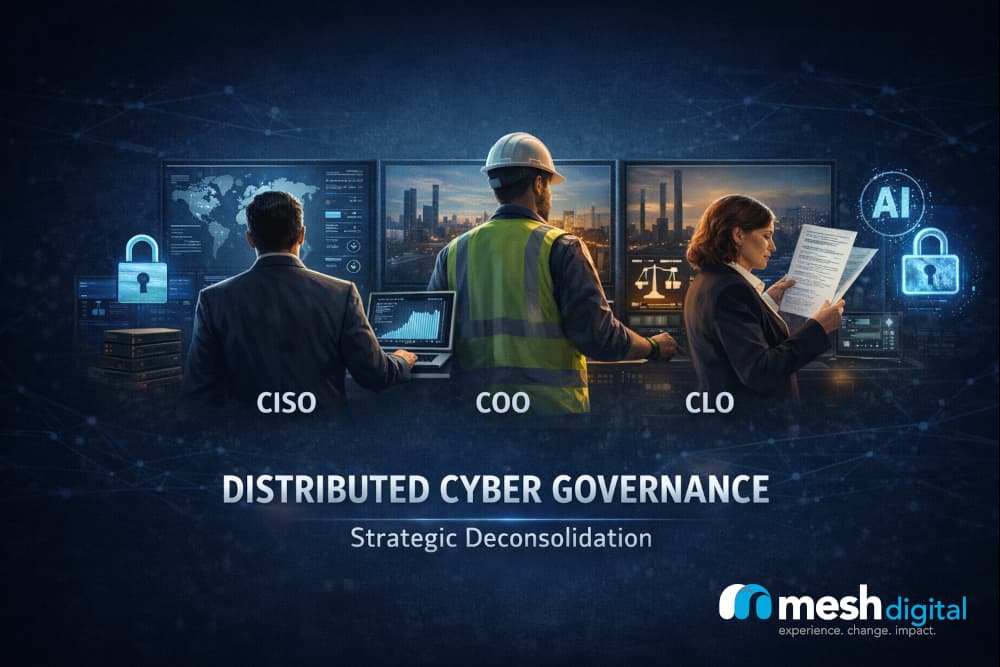
Executive Summary: The Board’s TL;DR
The Issue: The Chief Information Security Officer (CISO) role has suffered from "Scope Bloat," accumulating disparate responsibilities, from legal compliance to product engineering, that exceed the capacity of any single executive. This concentration of risk creates a Single Point of Failure (SPoF) and incentivizes a "buying tools" approach over solving systemic business problems.
The POV: Security is an enterprise-wide discipline, not a siloed department. The unmanageable CISO role isn't a failure of individual executives, but an organizational design flaw. For quality, scale, and remit alignment, Boards must mandate Strategic Deconsolidation. This means tactfully unbundling specific CISO mandates into C-suite adjacencies (Risk, Operations, Legal) with the natural authority to govern them.
The Solution (The "Office of" Model): You cannot simply delegate cyber responsibility to a non-technical executive without support.
- The CRO receives a Digital Risk Office (Quant analysts & IT Risk Managers) to own risk quantification.
- The COO receives Resilience Engineering resources to own operational uptime and recovery.
- The General Counsel receives Privacy & Governance staff to own regulatory defensibility.
The Transformation: Success requires a fundamental paradigm shift away from the "tooling centricity" that often dominates cybersecurity strategies. Technologies purchased off the shelf do not inherently solve systemic risk problems. True transformation requires the careful orchestration of people, processes, structures, change enablement, upskilling, and tools. We must shift our focus from Capital Expenditure (CapEx) on redundant security platforms to Operational Expenditure (OpEx) on organizational design and executive enablement. We must stop treating a structural governance problem as a technology deficit.
Section 1: The Fallacy of "Tool-Centric" Security
For the last decade, the primary corporate response to the growing cyber threat has been acquisition. CISOs, overwhelmed by expanding remits and massive OpEx/CapEx budgets, have often defaulted to purchasing technology, buying "single panes of glass," AI scanners, and automated platforms in an attempt to buy their way out of complexity.
The Reality: Tools, in isolation, do not solve problems. They are merely one component of a solution. If the underlying structure is broken, if a CISO is responsible for a risk they have no authority to mitigate, no amount of software will fix the governance gap.
To make the CISO role manageable and highly effective, Boards must pivot from a "Tool-Centric" strategy to a "Capability-Centric" strategy. To drive real change, organizations must orchestrate a holistic transformation across multiple dimensions:
- Structure: Redefining reporting lines, decision rights, and remit alignment (Divestiture).
- People & Skilling: Reskilling executives, staffing their "Offices" with technical translators, and fostering continuous training.
- Change Enablement: Managing the cultural shift required to make security a shared C-suite responsibility.
- Process: Integrating security gates seamlessly into business workflows (Procurement, Engineering, Legal) rather than bolting them on.
- Technology (Tools): Deploying tools specifically to automate and scale the processes defined above, not to replace them.
Strategic Imperative: We are moving from a model where the CISO is the "Sole Guardian" to one where the CISO is the "Strategy Architect," and the C-suite peers are the "Risk Owners."
Section 2: The Governance Engine – Empowering Executive Adjacencies
Divesting responsibility to a non-technical executive is a recipe for failure unless that executive is equipped with the "Digital Literacy" and the Technical Support Structures required to execute that duty. We propose creating specific "Offices" under these executives to bridge the technical gap.
2.1 The Chief Risk Officer (CRO)
- Inherited Remit: Cyber Risk Quantification (CRQ) and Enterprise Risk Appetite. The CISO no longer decides "how safe is safe enough"; the CRO does, based on capital at risk.
- The Support Structure: The Office of Digital Risk.
- The Staff: The CRO must hire Cyber Risk Quant Analysts (experts in FAIR models and Monte Carlo simulations) and IT Risk Managers (formerly in GRC). These staff report to the CRO, not the CISO.
- The Digital Literacy Uplift: The CRO requires executive education on Cyber-Financial Modeling, understanding how technical vulnerabilities (CVSS scores) translate into financial loss probabilities (Value-at-Risk).
- Why this works: The CRO already speaks "Capital" and "Regulation." By giving them the technical analysts, they can challenge the CISO effectively and defend risk decisions to the Regulators/Board.
2.2 The Chief Operating Officer (COO)
- Inherited Remit: Operational Resilience and Business Continuity. The CISO protects data; the COO protects uptime.
- The Support Structure: The Resilience Engineering Team.
- The Staff: Move Disaster Recovery (DR) architects and Business Continuity Planners from IT/Security to Operations. In industrial sectors, OT Security Engineers should also report here to align security with production safety.
- The Digital Literacy Uplift: The COO must be upskilled in Digital Dependency Mapping, understanding how a cloud outage impacts the factory floor or supply chain.
- Why this works: The COO controls the budget for "keeping the lights on." When they own cyber resilience, security becomes an operational imperative, not an IT tax.
2.3 The General Counsel (CLO)
- Inherited Remit: Regulatory Defensibility, Incident Notification, and Privacy Governance.
- The Support Structure: The Privacy & Digital Ethics Office.
- The Staff: Privacy Engineers (who understand code and data flows) and Governance Risk & Compliance (GRC) attorneys embedded within Legal.
- The Digital Literacy Uplift: Training on Data Lineage and AI Model Provenance. The GC needs to understand where data lives to defend how it is used.
- Why this works: Incident response is now primarily a legal workflow (SEC 4-day ruling). The GC is best positioned to manage privilege, liability, and public disclosure.
Section 3: The Evolving Mandate – New Roles for New Risks
While some responsibilities move to existing roles, leading organizations are finding that specific emerging domains require dedicated leadership.
3.1 The Chief AI Officer (CAIO)
- Current State: Leading organizations have already established this role or some variance there of. The "newness" is gone; the challenge is now Governance Integration.
- The Interface: The CAIO owns Model Utility (making AI work for the business) and Algorithmic Safety (Bias/Hallucination). The CISO owns Model Security (Adversarial attacks/Model theft).
- The Support Structure: The CAIO needs a Data Science Assurance Team, technical auditors who can "Red Team" AI models for safety before deployment.
- Strategic Pivot: We must stop asking the CISO to govern "AI Ethics." That is a socio-technical problem, not a security one.
3.2 The Chief Trust Officer (CTrO)
- The Concept: A role designed to monetize security.
- The Remit: Aggregating Customer Assurance, ESG (Data Ethics), and Transparency.
- The Support Structure: Customer Security Trust Agents, staff dedicated to answering customer questionnaires, managing trust portals, and facilitating customer audits.
- Value: This removes the "sales enablement" burden from the CISO, allowing the CISO to focus on threats while the CTrO focuses on revenue retention.
Section 4: The Tactical Engine – Simplification via Platform Engineering
You cannot divest responsibility if the execution requires a PhD in Cryptography. We must use Platform Engineering to abstract complexity, allowing the CISO to step back from day-to-day operations.
4.1 The "Secure Paved Road"
- The Strategy: Embed security controls (IAM, Encryption, Logging) into the developer platforms (Kubernetes, CI/CD).
- The Divestiture:
- Old Way: CISO team manually reviews every firewall change and code commit. (Bottleneck).
- New Way: CTO/CIO owns the Platform. The CISO defines the Policy (e.g., "All buckets must be encrypted"), and the Platform enforces it automatically.
- Outcome: Security becomes a Product Feature of the IT platform, managed by Engineering, not a ticket managed by Security.
4.2 Automation as a Force Multiplier
- The Strategy: Deploy Agentic AI in the SOC to handle Tier 1 analysis.
- The Divestiture: This allows the "Eyes on Glass" monitoring function to potentially shift to a Unified Command Center under IT Operations (NOC/SOC fusion), with the CISO retaining high-level Threat Intelligence and Incident Command.
Section 5: Industry Model A – BFSI (The Federated Risk Utility)
- Context: High regulation (DORA, SEC, OCC) requires constant validation.
- The Divestiture Model:
- CRO: Owns the Cyber Risk Utility, a shared service center that continuously tests controls and reports to regulators.
- CIO/CTO: Owns First Line Risk. They are accountable for patching and secure configuration.
- CISO: Moves to Second Line Oversight. They no longer "fix" the patches; they "monitor" the CIO's fixing of patches.
- Key Enabler: A "Governance Risk & Compliance (GRC) Platform" that automates the feed of data from IT to Risk, bypassing manual spreadsheets.
Section 6: Industry Model B – Healthcare (The Clinical Convergence)
- Context: Patient Safety is paramount. The CISO cannot secure MRI machines they don't understand.
- The Divestiture Model:
- Chief Clinical Officer / CMIO: Owns Patient Safety Risk. They lead the "Digital Safety Committee."
- Clinical Engineering (Biomed): Inherits full responsibility for IoMT (Internet of Medical Things) security. They are upskilled with cyber training to patch and segment medical devices.
- CISO: Focuses on Corporate IT (EHR, Email) and provides Threat Intelligence to the Clinical Engineering team.
- Key Enabler: IoMT Security Platforms (e.g., Armis/Ordr) managed by Clinical Engineering, providing visibility into the medical device fleet.
Section 7: Comprehensive RACI Matrix (Target Operating Model)
This matrix defines the Target State for a deconsolidated, manageable cyber governance model.
Roles:
- CISO: Chief Information Security Officer (Strategic focus)
- CRO: Chief Risk Officer (Risk Quant focus)
- COO: Chief Operating Officer (Resilience focus)
- GC: General Counsel (Regulatory focus)
- CIO: Chief Information Officer (Implementation focus)
- CAIO: Chief AI Officer (Model Safety focus)
- Clin. Eng: Clinical Engineering / Biomed (Healthcare specific)
Legend:
- R: Responsible (Does the work)
- A: Accountable (The "neck to choke")
- C: Consulted (Two-way communication)
- I: Informed (One-way communication)
| Functional Domain | Activity | CISO | CRO | COO | GC | CIO / CTO | CAIO | Clin. Eng |
|---|---|---|---|---|---|---|---|---|
| Enterprise Governance | Defining Cyber Risk Appetite | C | A | C | C | I | I | I |
| Regulatory Reporting (SEC/DORA) | C | R | I | A | I | I | I | |
| Board Reporting (Risk Quant) | C | A | I | I | I | I | I | |
| Operational Security | Vulnerability Management (Patching) | C | I | I | I | A | I | I |
| Identity & Access Mgmt (IAM) | C | I | I | I | A | I | I | |
| Secure Software Development | C | I | I | I | A | I | I | |
| Resilience | Business Continuity Planning (BCP) | C | I | A | I | R | I | I |
| Disaster Recovery Testing | C | I | R | I | A | I | I | |
| OT / Factory Security (If applicable) | C | I | A | I | R | I | I | |
| Incident Management | Technical Incident Response | A | I | C | C | R | I | I |
| Breach Notification & Disclosure | C | I | I | A | I | I | I | |
| Crisis Communications | C | I | A | C | I | I | I | |
| Emerging Tech | AI Model Safety (Bias/Ethics) | I | C | I | C | I | A | I |
| AI Infrastructure Security | A | I | I | I | R | C | I | |
| Shadow AI Governance | C | I | I | C | I | A | I | |
| Healthcare Specific | IoMT Device Security Lifecycle | C | I | I | I | I | I | A |
| Patient Safety Risk Assessment | C | I | I | I | I | I | R |
Conclusion
The era of the "Hero CISO" is over, as well as, their "no win" predicament. It is functionally impossible for one individual to carry the water for Legal, Risk, Operations, and Engineering simultaneously. By adopting this Strategic Deconsolidation model, Boards can ensure that cyber risk is managed by the executives who actually have the authority to mitigate it, supported by the technical teams necessary to do the job.