Governing the Agentic Enterprise: From "Human-in-the-Loop" to "Strategy-in-Motion"
AI pilots are over. The Agentic Era demands "Strategy-in-Motion™." We propose a 3-Tier Trust Model to govern autonomous digital workers, replacing static policies with real-time "Circuit Breakers." It’s time to move from "Human-in-the-Loop" to "Human-on-the-Loop."

Abstract (TL;DR)
The pilot phase of Generative AI is over. As we settle into 2026, the enterprise landscape has shifted from static "prompts" to autonomous "agents" systems capable of planning, reasoning, and executing complex workflows without constant supervision. This shift renders 2024-era governance models obsolete. This article outlines a modernized framework for Agentic Governance, moving beyond simple compliance to active orchestration. We argue that in an era of autonomous digital workers, governance must evolve from a gatekeeping function into a system of "guardrails and guidance" that enables high-velocity innovation while mitigating the emerging risks of "Shadow Agents" and "Agentic Sprawl."
Introduction: The Operational Reality of 2026
Two years ago, the conversation was about "controlling the prompt." Today, it is about "orchestrating the fleet."
By early 2026, leading enterprises are moving past the novelty of Large Language Models (LLMs) to the utility of Agentic AI. These are not just chatbots waiting for questions; they are autonomous software entities with agency; authorized to access APIs, manipulate data, and trigger real-world transactions to achieve broad objectives.
This autonomy brings a new class of risk. The "Shadow IT" of the cloud era and the "Shadow AI" of years prior have mutated into "Shadow Agents" unauthorized autonomous workflows running on local machines or third-party platforms, using unmanaged non-human identities (NHIs), executing business logic with little to no oversight.
Traditional technology governance designed for static software releases and human decision chains cannot keep pace with software that decides how to execute a task. We need a reimagined governance architecture that treats agents not just as tools, but as digital employees with identity, authority, and accountability.
Redefining Governance: The "Agentic" Shift
In the past, governance was a checklist applied before deployment. In the agentic era, governance must be continuous and programmatic. It is no longer about "Is this software safe to deploy?" but "Is this agent behaving within its bounds right now?"
Effective Agentic Governance rests on three new pillars:
1. Identity and Authority (IAM for Agents)
Agents must be treated as distinct identities within the enterprise, as part of a next generation identity and access management approach we call IAM 3.0. Just as we don't give a new human hire "admin access" to everything, we cannot deploy agents with broad API keys.
- The Shift: From "Service Accounts" to "Agent Personas." Every agent must have a cryptographic identity linked to a specific human owner and a defined "Scope of Autonomy."
- The Mechanism: Use "Just-in-Time" (JIT) privilege elevation. An agent should only have access to a specific database table during the execution of a relevant task, revoking access immediately after.
2. Bounded Autonomy & Circuit Breakers
The concept of "Human-in-the-Loop" (HITL) is failing at scale. If an enterprise deploys 5,000 agents to handle supply chain logistics, human review of every action creates a paralysis bottleneck.
- The Shift: From HITL to "Human-on-the-Loop" (HOTL). We must define "Bounds of Autonomy" thresholds for financial value, data sensitivity, or confidence levels.
- The Mechanism: Agents operate autonomously within these bounds. If an agent attempts an action outside its bounds (e.g., a refund >$1,000), a "Circuit Breaker" trips, freezing the workflow and escalating to a human. This allows speed for the routine and safety for the exception.
3. Observable Reasoning (Audit Trails 2.0)
Logging outputs is insufficient. When an agent makes a decision (e.g., "Deny this insurance claim"), we need to know why. Think XAI here.
- The Shift: From "Log Files" to "Reasoning Traces." Governance (and future regulations) require that agents log their "Chain of Thought" into an immutable ledger.
- The Mechanism: This "Flight Recorder" approach ensures that if an agent hallucinates or shows bias, we can replay its logic to understand if the error was in the prompt, the model, or the retrieval context (RAG).
A Framework for Sustainable Innovation
To operationalize this, we propose the "3-Tier Agentic Trust Model" to categorize and govern workloads:
| Tier | Agent Role | Governance Model | Examples |
|---|---|---|---|
| Tier 1: Copilot | Assists a human; human executes the final click. | Passive: Standard IT policy; user bears full responsibility. | Drafting emails, coding assistants. |
| Tier 2: Autopilot | Executes repetitive tasks within strict rules. | Bounded: Hard-coded limits; periodic human audit and exception handling. | Invoice processing, Tier 1 Customer Support. |
| Tier 3: Agentic | Plans and executes multi-step goals; adapts to errors. | Active: Real-time monitoring; mandatory "Circuit Breakers"; dedicated "Agent Manager" role. | Supply chain re-routing, autonomous cyber-defense. |
Anti-Patterns in the Agentic Age
As organizations rush to deploy, we observe three dangerous governance "anti-patterns" that stifle innovation or invite catastrophe.
1. The "Human-in-the-Loop" Bottleneck
- The Trap: Mandating human approval for every agent action to "reduce risk."
- The Result: The ROI of AI is destroyed by labor costs. The agents wait in queues, and the humans become "rubber stampers" due to fatigue, approving actions without reading them.
- The Fix: Adopt Governance by Exception. Trust the bounds, not the transaction.
2. The "Black Box" Liability
- The Trap: Buying "All-in-One" agent platforms that do not expose the agent's reasoning logs or tool usage history.
- The Result: When an agent violates a regulation (e.g., GDPR, FCRA), you cannot prove why it happened or who is at fault.
- The Fix: Mandate "Explainability by Design" in procurement. If the agent can't tell you why it did X from the lens of an auditor or a regulator, it doesn't go into production.
3. Static Policy in a Dynamic World
- The Trap: Governance teams issuing PDF policies ("Do not use Agent X for Y").
- The Result: "Shadow Agents" ignore PDFs. By the time the policy is published, the technology has changed.
- The Fix: Policy as Code. Governance rules must be written into the API gateways and agent orchestration layers (e.g., LangChain/LangGraph guardrails) to physically prevent unauthorized actions.
Conclusion: Governance as a Velocity Enabler
In 2026, Technology Governance is no longer the "Department of NO." It is the Department of "How Fast Can We Safely Go?"
The enterprises that will win in the Agentic Economy are not those with the smartest models, but those with the cleanest data and the clearest guardrails. By establishing a governance framework that creates safe spaces for autonomous action, leaders can unlock the true promise of Agentic AI: the ability to scale intelligence, not just productivity.
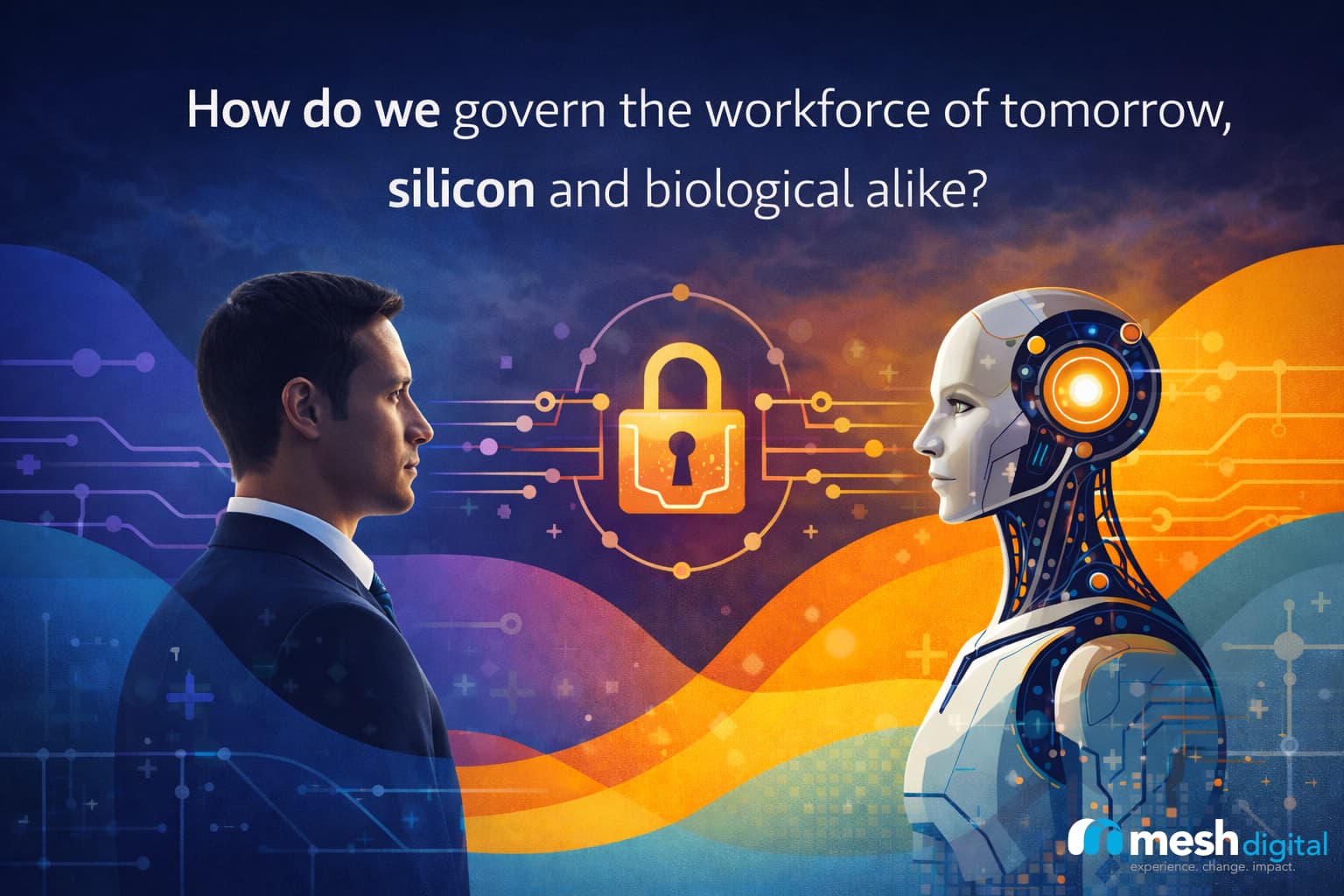
The question for Technology Leaders today is not "How do we control AI?" but "How do we govern the workforce of tomorrow, silicon and biological alike?"
About Mesh Digital
Mesh Digital is an AI-native boutique management consultancy focused on Strategy-in-Motion™. We partner with forward-thinking Executives and technology leaders to dismantle legacy technical debt and operationalize the next generation of autonomous, agentic innovation.